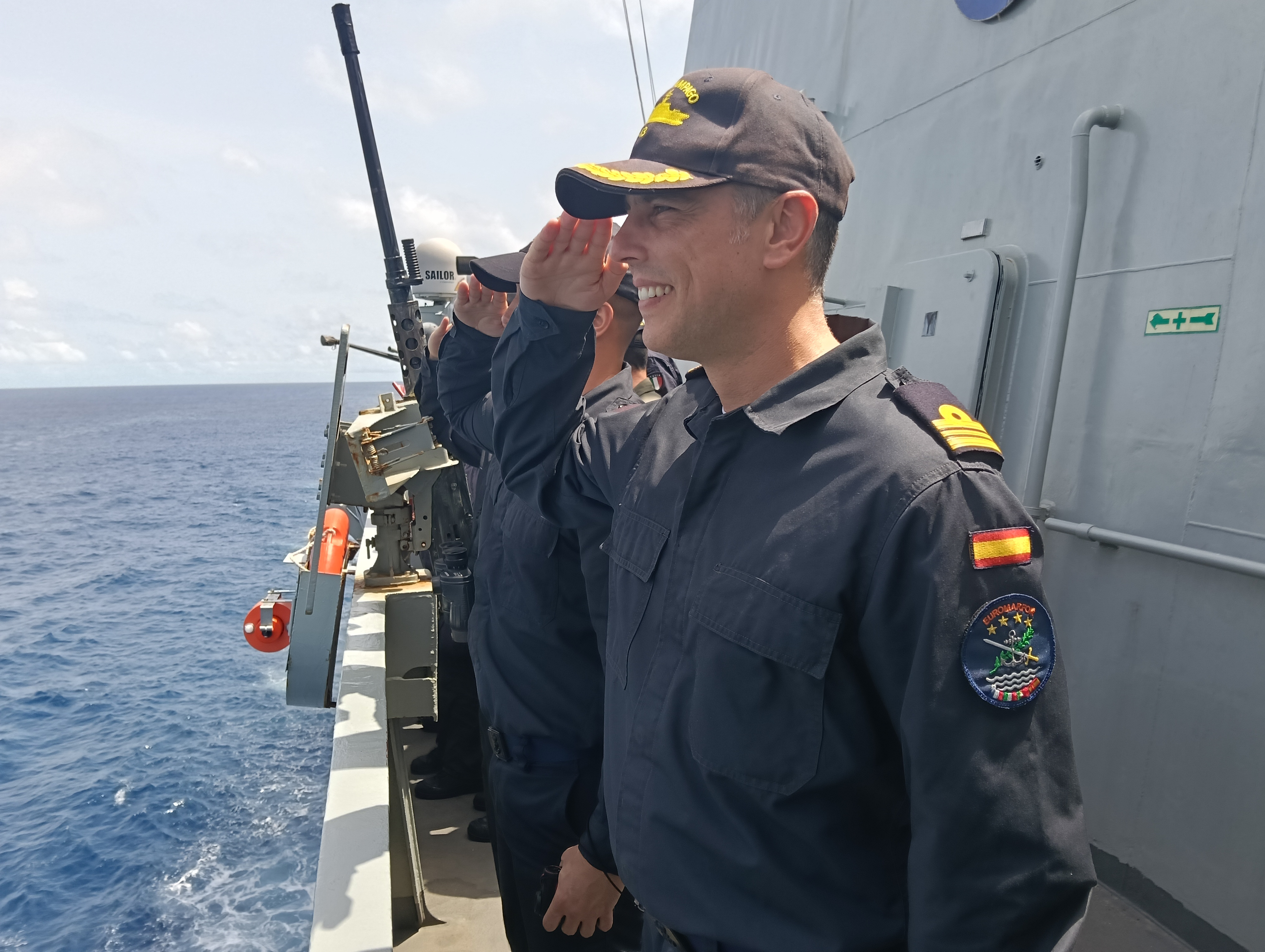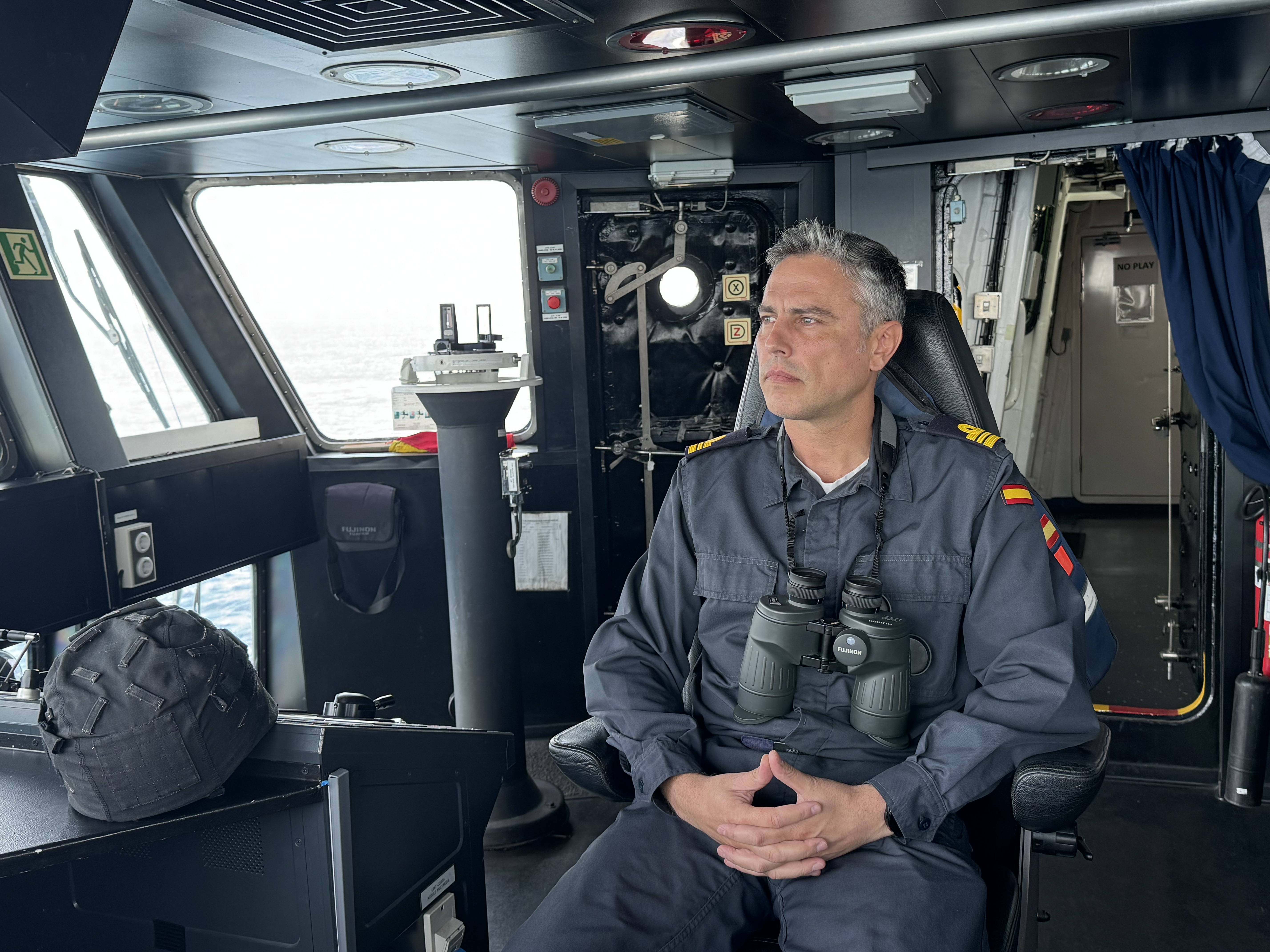


Commander Meijueiro, Commanding Officer of the Relámpago: ‘Maritime security in the Gulf of Guinea has a direct impact on the wellbeing of Spanish citizens’
- Since 3 February, the Offshore Patrol Vessel (OPV) Relámpago has been operating in African waters in close cooperation with coastal nations as part of the European Union’s Coordinated Maritime Presences
Since 2010, Spanish Navy vessels have been patrolling the western coast of Africa and the Gulf of Guinea — initially on an intermittent basis, but increasingly with greater frequency and duration. Their missions include maritime surveillance, military cooperation with littoral states, and support to defence diplomacy. Since 2021, these efforts have also fallen under the framework of the EU’s Coordinated Maritime Presences (CMP) — a collective and coordinated European initiative aimed at contributing to regional stability through joint naval deployments in the Gulf of Guinea.
Since departing Las Palmas Naval Base on 3 February, the OPV Relámpago has represented Spain’s current contribution to this European cooperation initiative, continuing until 18 June. Leading the deployment is Commander Víctor Meijueiro Morado, a seasoned officer with extensive experience in national, NATO and EU naval operations. In this interview, the Commanding Officer reflects on the significance of this African deployment: a demanding mission that the ship’s company faces ‘with teamwork, professionalism, and a strong sense of duty’.
What is the aim of the EU’s Coordinated Maritime Presences initiative, and what benefits does it offer Spain?
This European concept is relatively new, having been approved in January 2021. Through its implementation, we are strengthening collective commitment and coordination of naval assets operating in the Gulf of Guinea — as well as in the Western Indian Ocean — while promoting international maritime partnerships from within the EU.
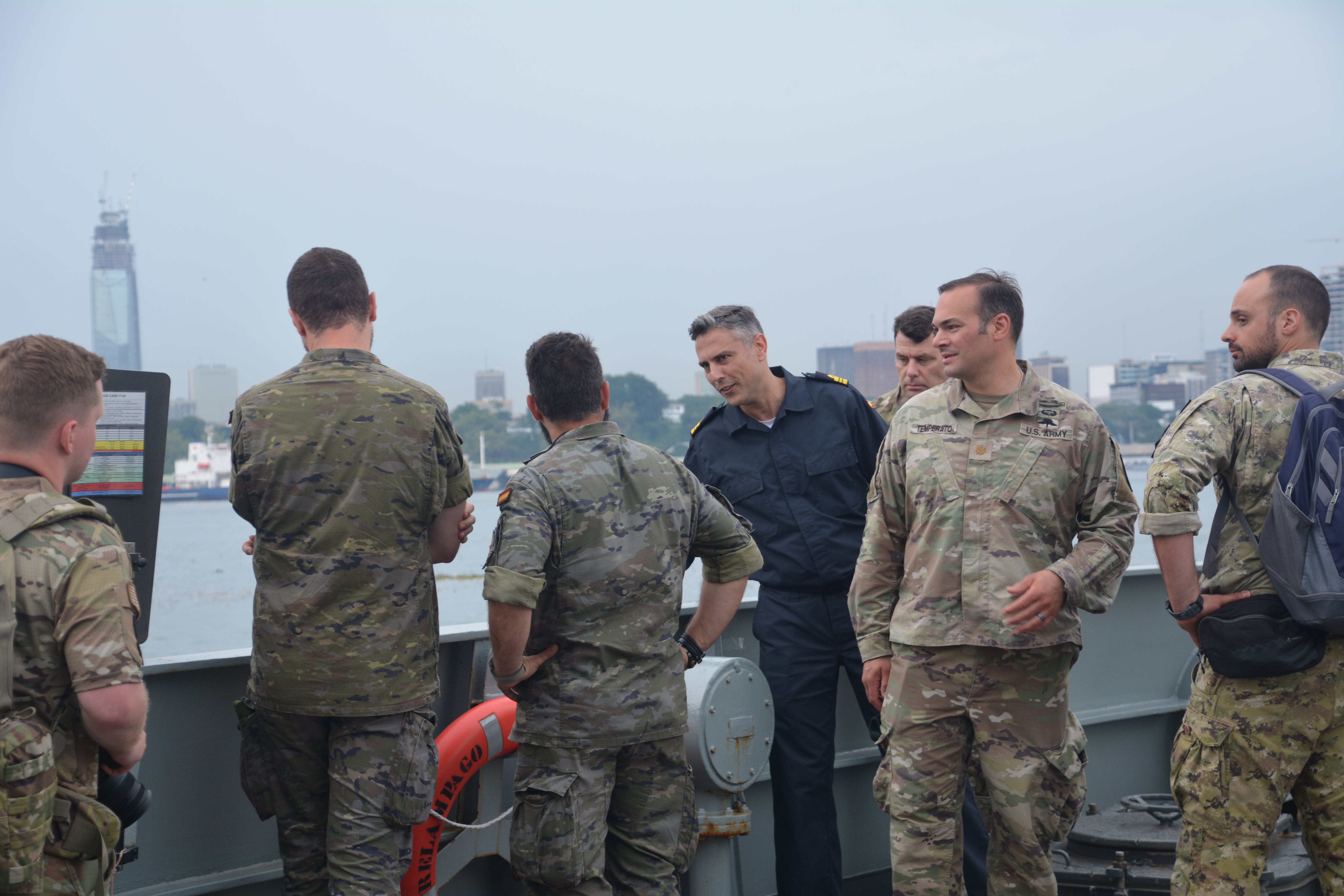
In our case, since we began our patrol in early February, our main objective has been to enhance maritime security, strengthen friendship and cooperation with coastal nations, and increase Spanish presence in support of national interests in the region. Cooperation with regional navies is increasingly consolidated: we share knowledge, conduct joint exercises, and learn from one another — all of which enhances collective maritime security in the Gulf of Guinea.
Other EU member states, including France, Italy, and Portugal, are also taking part in this project. Our efforts are coordinated to ensure more effective maritime surveillance — and with greater resources — to support local nations, who regard our presence as a clear signal of Europe’s commitment and support.
As for Spain, it is essential to stress that our national security is not built solely within our borders. It begins where the threats to peace, stability, and our national interests first emerge. Spain is a maritime nation, and the Gulf of Guinea is a strategic area for us. Spanish fishing vessels operate in these waters, Spanish-linked maritime industries are present here, and vital commercial sea lanes pass through the region. In short, although geographically distant, the Gulf of Guinea has a direct influence on daily life and the wellbeing of Spanish citizens. This more than justifies our integrated cooperation efforts in the region.
Criminal activity has increased in recent years in the Gulf of Guinea. What is the Relámpago’s role in responding to these threats?
The Relámpago plays an active role in deterring and preventing illicit maritime activity through a continuous naval presence in high-risk zones. However, we do not carry out offensive operations to combat maritime crime — which ranges from piracy and drug trafficking to illegal fishing and maritime robbery. Instead, we employ our onboard sensors, including drones, to detect and report suspicious activity to coastal states.
In addition, we support regional navies by training their units in anti-piracy operations, and we provide escort to Spanish-linked vessels upon request.
Naturally, should a Spanish-flagged vessel come under attack in the Gulf of Guinea — or anywhere else in the world — we would respond in accordance with international law.
After months at sea in African waters, what are the main challenges for the Relámpago and its crew?
For the Relámpago, this deployment is an excellent opportunity to demonstrate both its operational efficiency and readiness. But it is also a significant logistical and human challenge. Coordinating with the various West African coastal nations and their respective maritime operation centres is demanding. Prolonged deployments far from home bring physical and psychological strain, especially in a harsh climate.
That said, what stands out above all is the professionalism and camaraderie of the ship’s company. Morale remains high, and the crew is motivated and committed. Many of the 71 personnel on board have extensive experience in such deployments, and together we are fully prepared to face the demands of this mission. Naturally, we all look forward to returning to our families — but until then, we remain fully focused on the task at hand, united by a strong team spirit, professionalism, and a sense of duty.
We are fully aware that our presence and efforts here contribute directly to improving maritime security in a strategically vital region for Spain, and that is our greatest motivation.
Fotos