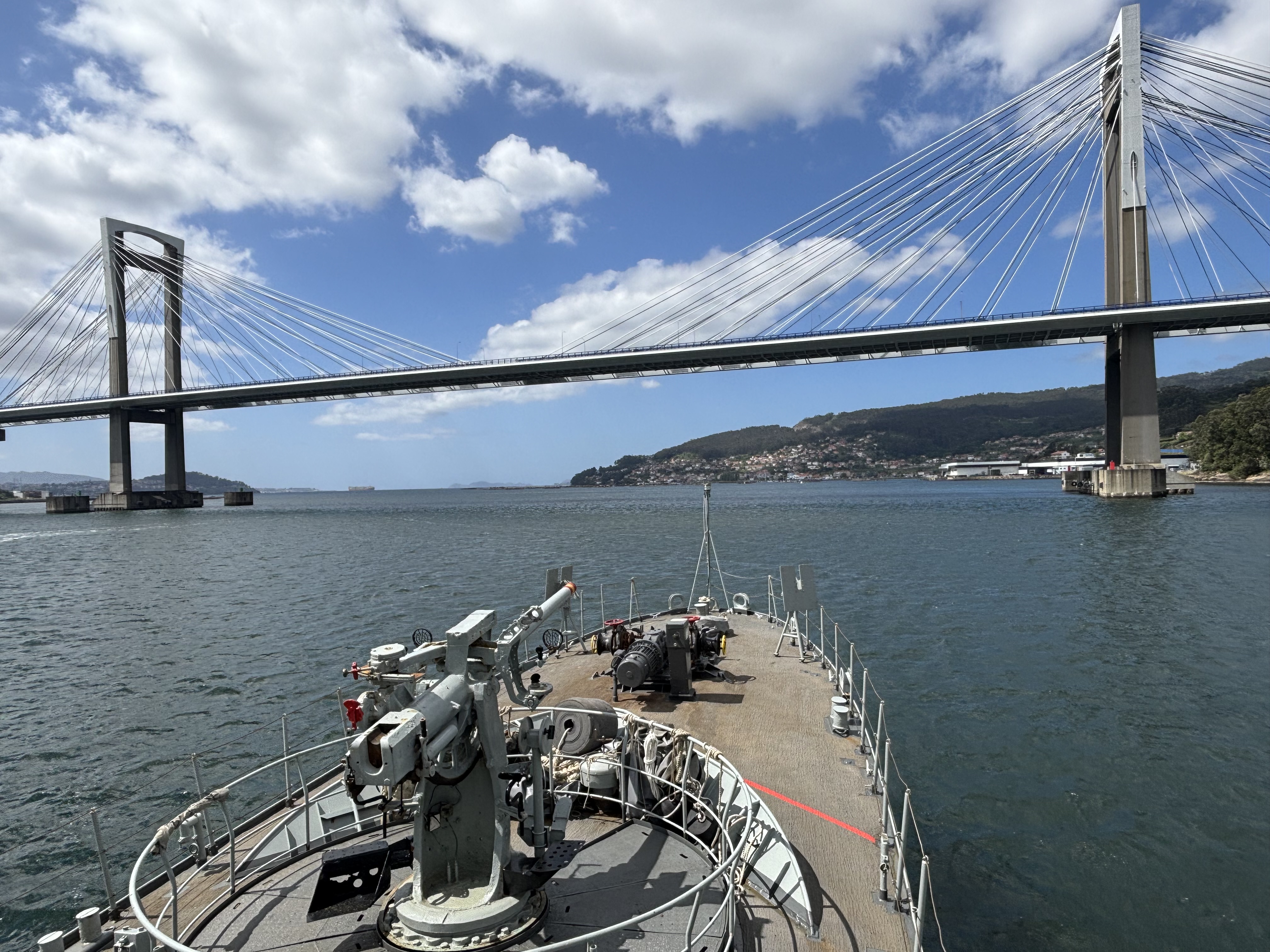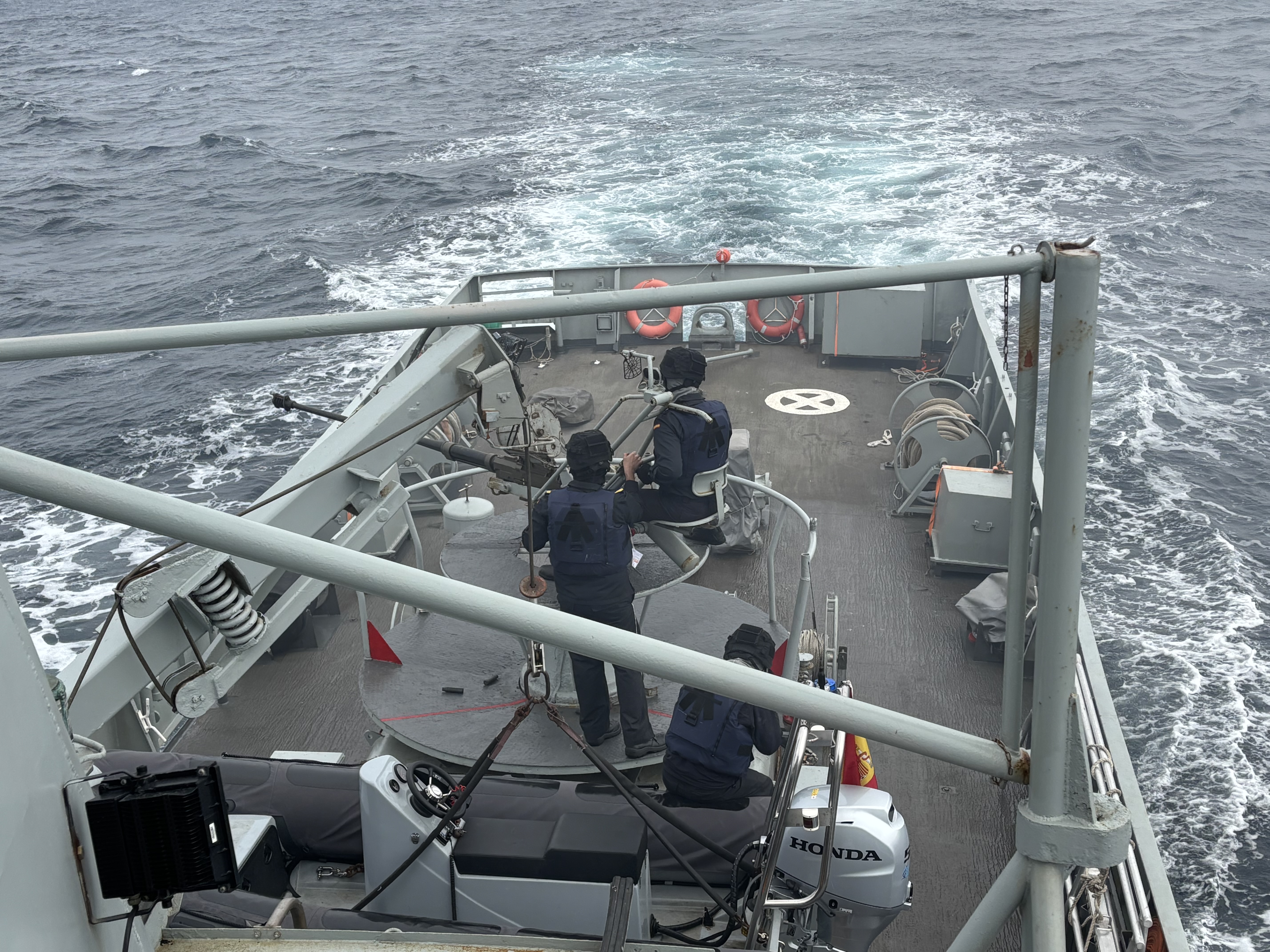


The patrol vessel ‘Tabarca’ concludes its maritime surveillance operation
-
The vessel has carried out patrols to maintain a presence and act as a deterrent along the Galician coast and the border with Portugal
The patrol vessel ‘Tabarca’ (P-28) — commanded by Lieutenant José Enrique Delgado González — has carried out maritime security and surveillance tasks in the waters off the Galician coast and the border with Portugal. With the vessel integrated into the Maritime Operational Command (MOC), and under the operational control of the Commander of Operations (CMOPS), it has helped to ensure the comprehensive protection of waters of national interest.
Among the tasks assigned during this deployment, the ‘Tabarca’ has carried out Maritime Security Operations (MSO), which consist of activities to verify and control maritime traffic in order to ensure freedom of navigation.
The patrol vessel’s crew has also carried out visits to fishing and recreational vessels, actions which help to raise awareness of the Navy’s work at sea. Through these interactions, information is gathered on the activities and dynamics of the fishing community, thereby improving understanding of the maritime environment.
The ’Tabarca’ has combined operational duties with crew training, including exercises in internal security and defence against asymmetric threats.
Patrol vessel ‘Tabarca’ (P-28)
The ‘Tabarca’ is the eighth vessel in a series of ten, known as the ‘Anaga’ class, of which three remain in service today. Each vessel in this class is named after an island or islet off the Spanish coast. ‘Tabarca’ is the name of a small island in Alicante, situated south-west of the town of Santa Pola.
This patrol vessel was built by Empresa Nacional Bazán at its shipyard in San Fernando, Cádiz, launched on 23 December 1980 and handed over to the Navy on 31st December 1981.
The patrol vessel ‘Tabarca’ is attached to the Maritime Action Force, specifically to the Command of the Maritime Action Force Units in Ferrol (MARFER in Spanish), and has been based at the Naval Military Academy in Marín —Pontevedra— since it entered service in 1981.
The vessel’s main mission is to carry out maritime surveillance through a naval presence and the control of maritime areas of national interest, as a specific mission within the scope of the Navy. It also regularly assists in the training of cadets at the Naval Military Academy.
Maritime Operational Command and the OPVDs
The Maritime Operational Command (MOC) is a component of the Armed Forces’ operational structure, reporting to the Chief of Defence and is responsible, at its level, for the planning, conduct and monitoring of operations relating to presence, surveillance and deterrence in maritime areas under national sovereignty, responsibility and interest. It is under the command of the Admiral of Maritime Operations (ALMART in Spanish), Vice-Admiral Vicente Cuquerella Gamboa, and is headquartered in Cartagena.
As part of the MOC, various Navy vessels carry out, under the operational control of the Operations Command, Presence, Surveillance and Deterrence Operations, which are an effective tool for maintaining surveillance of areas of sovereignty and interest. This enables a better understanding of the maritime environment, contributes to its comprehensive protection —in conjunction with other state institutions— and also allows for the early detection of threats and facilitates an immediate and viable response to a potential crisis.
Together with the MOC, the Land Operational Command (LOC), Air Operational Command (AOC), Space Operational Command (SPOC) and Cyber Operational Command (CYOC) form the structure of the Permanent Commands. On a daily basis, some 850 military personnel from the Armed Forces are involved in permanent operations, which are conducted under the operational control of the Operations Command.
Fotos