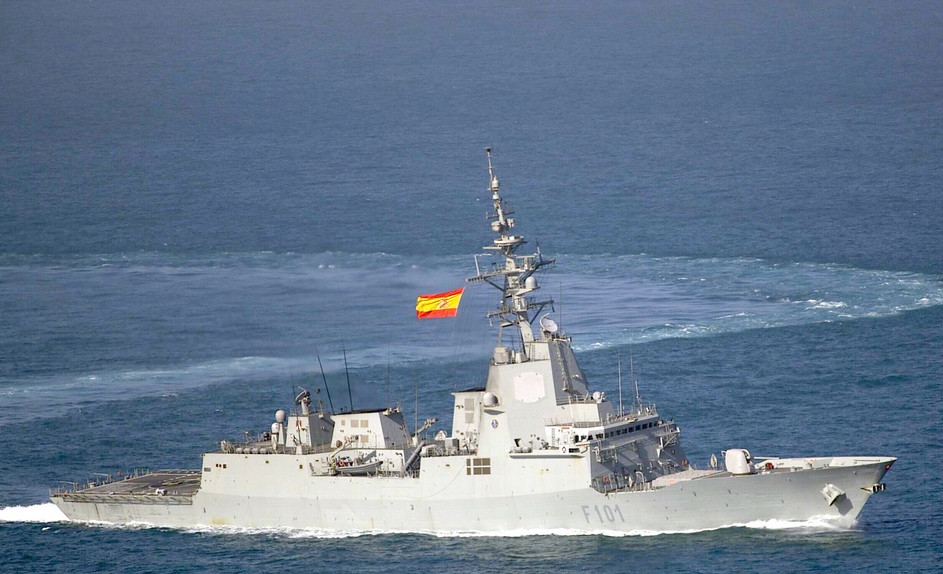


The Frigate Álvaro de Bazán Conducts Surveillance Activities on Russian Naval Units after Completing Its Deployment in SNMG-2
- Since entering Spanish waters in the Alboran Sea, the frigate has been engaged in surveillance and tracking of three Russian vessels in the western Mediterranean region
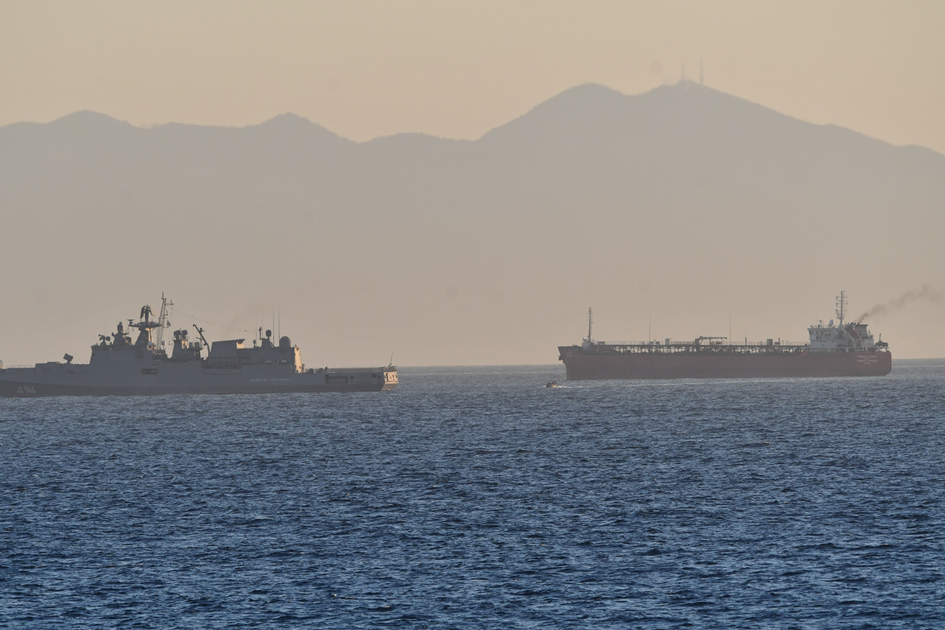
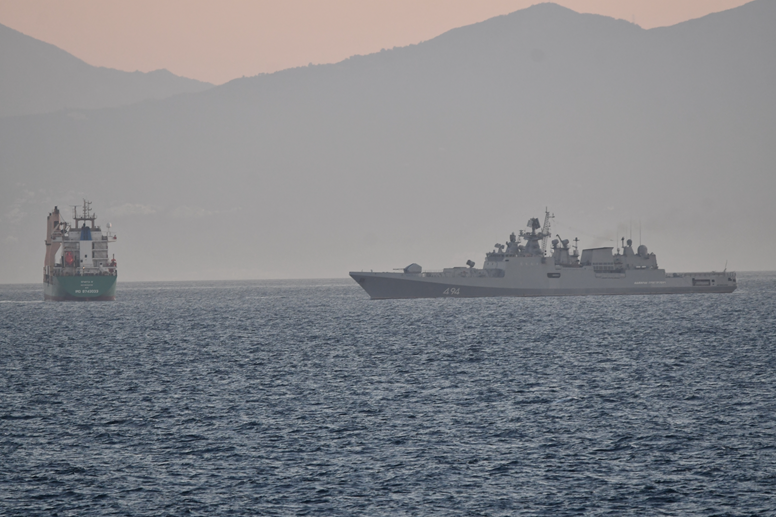
After completing its deployment with the NATO Standing Maritime Group 2 (SNMG-2), the frigate Álvaro de Bazán was assigned by the Maritime Operational Command (MOM in Spanish) to carry out, under the operational control of the Commander of Operations Command, surveillance and tracking of a convoy of Russian units — both civilian and military — as they sailed through the Alboran Sea towards the Strait of Gibraltar.
To fulfil this new mission of presence, surveillance, and deterrence, the frigate Álvaro de Bazán expedited its departure from the port of Cartagena and intercepted the three Russian units forming the convoy. The first vessels detected were the Russian-flagged merchant ships ‘General Skobelev’ and ‘Sparta IV’, followed by the frigate ‘Admiral Grigorovich’, the lead unit of its class, which was providing protection for the civilian vessels.
Over several days of navigation, the Álvaro de Bazán maintained naval surveillance of the Russian ships until they reached Portuguese sovereign waters. At this point, a Portuguese patrol vessel took over the task of continuing the convoy's tracking as it navigated north from the Atlantic Ocean. The frigate then proceeded towards the El Ferrol Arsenal, where it is now docked.
During its time in SNMG-2, the frigate also conducted surveillance missions — at the request of the SNMG-2 commander — on various Russian vessels, including the Russian submarine ‘Krasnodar’, as well as the frigates ‘Admiral Golovko’ and once again the ‘Admiral Grigorovich’ in eastern Mediterranean waters.
Maritime Operational Command (MOM)
The Maritime Operational Command is part of the operational structure of the Spanish Armed Forces, subordinate to the Chief of Defence (JEMAD in Spanish). It is responsible for the planning, conduct, and monitoring of permanent operations for the surveillance and security of maritime spaces under Spanish sovereignty, responsibility, and national interest. The MOM is under the command of the Admiral of Maritime Action and is headquartered in Cartagena.
Presence, Surveillance, and Deterrence Operations (OPVD)
Presence, Surveillance, and Deterrence Operations (OPVD) are an effective tool for maintaining surveillance over sovereign maritime spaces, enabling early threat detection and providing a viable and immediate response in the event of a potential crisis. In the case of naval OPVDs, the fundamental objective is to ensure maritime security across its broad spectrum: from situation control and vessel registration, to monitoring, reporting, and, when necessary, acting on illicit activities at sea or preventing environmental damage. In all cases, and in collaboration with other state institutions, these operations contribute to the protection of our seas, which is vital to the daily life of the Spanish people.
The Land Operational Command (MOT), Maritime Operational Command (MOM), Air Operational Command (MOA), Space Operational Command (MOESPA), and Cyberspace Operational Command (MOC) form the structure of the Permanent Commands. Daily, around 3,000 personnel from the Armed Forces are involved in these permanent operations, under the operational control of the Operations Command.
Fotos