

Basic training course on mission planning with unmanned aerial systems concludes in Senegal
- This is the first training exercise organised by the Spanish military in collaboration with the Senegalese Armed Forces in this field
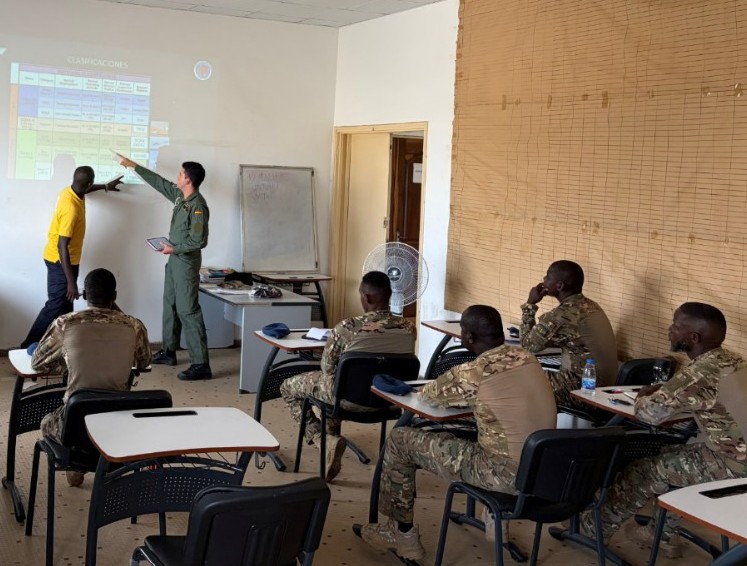
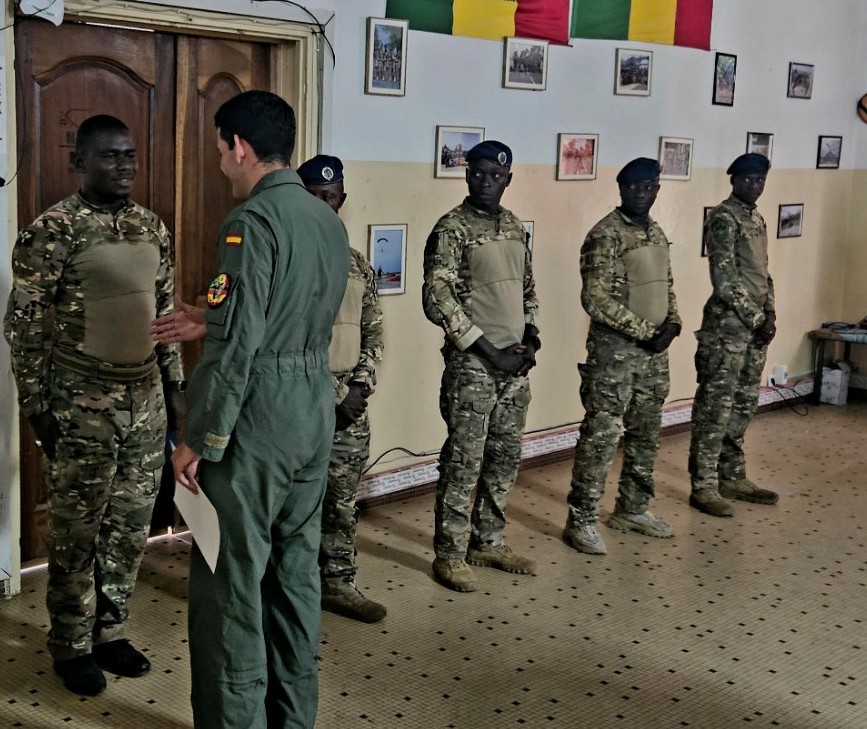
In Senegal, staff from the Military School of Unmanned Aerial Systems (EMUAS), the Air and Space Force, have developed a new Cooperative Security Activity aimed at providing basic training in mission planning with RPAS (Remotely Piloted Aircraft Systems) and their integration into air operations to members of the Force Spéciale Aérienne (FSA) of the Senegalese Air Force.
This marks the first training action carried out with the Senegalese Armed Forces specifically in the field of unmanned aerial systems. In particular, one of the main components of the activity was devoted to mission planning using MALE (Medium Altitude Long Endurance) systems, whose capabilities enable long-duration missions to be carried out. The trainees worked on the various elements required for effective planning, including fuel calculations, mission timing, the structured preparation of briefings, and the design of nominal and contingency routes.
This training, delivered by the Military School of Unmanned Aerial Systems, contributes to the development of capabilities that are becoming increasingly important in today’s operational environments. Training in the integration of RPAS systems into the planning and conduct of operations is a constantly evolving field of technology and, at the same time, strengthens bilateral cooperation and professional ties between the Armed Forces of Spain and Senegal.
The head of the FSA, Commander Ibrahima Mamadou Tall, who has coordinated the exercise, emphasised the growing importance of unmanned aerial systems in current conflicts and the need to continue making progress in training personnel in this field, including the possibility of organising future training activities in Spain. He also expressed his gratitude for the work of the Spanish instructors and the commitment shown by the trainees throughout the course.
For his part, the Spanish Armed Forces’ liaison officer in Senegal at the time, Commander Félix Javier Medina Matesanz, emphasised the importance of developing new technological capabilities to address emerging challenges in the field of defence and, in particular, those related to the growing use of unmanned aerial systems. He also expressed his gratitude for the work carried out by the Spanish instructors and highlighted the willingness, availability, effort and determination demonstrated by the participating Senegalese personnel.
Cooperative Security Activities
Cooperative Security Activities are a key tool for strengthening the military capabilities of partner countries and contributing to their security through cooperation and the exchange of knowledge. Through these activities, Spain and Senegal continue to strengthen practical and sustained cooperation, based on the exchange of experiences, joint training and a shared commitment to regional security and stability.
In this regard, Cooperative Security Activities reaffirm Spain’s commitment to international stability, demonstrating that specialised peer-to-peer training is key to building Armed Forces that are prepared to face today’s challenges.
Fotos