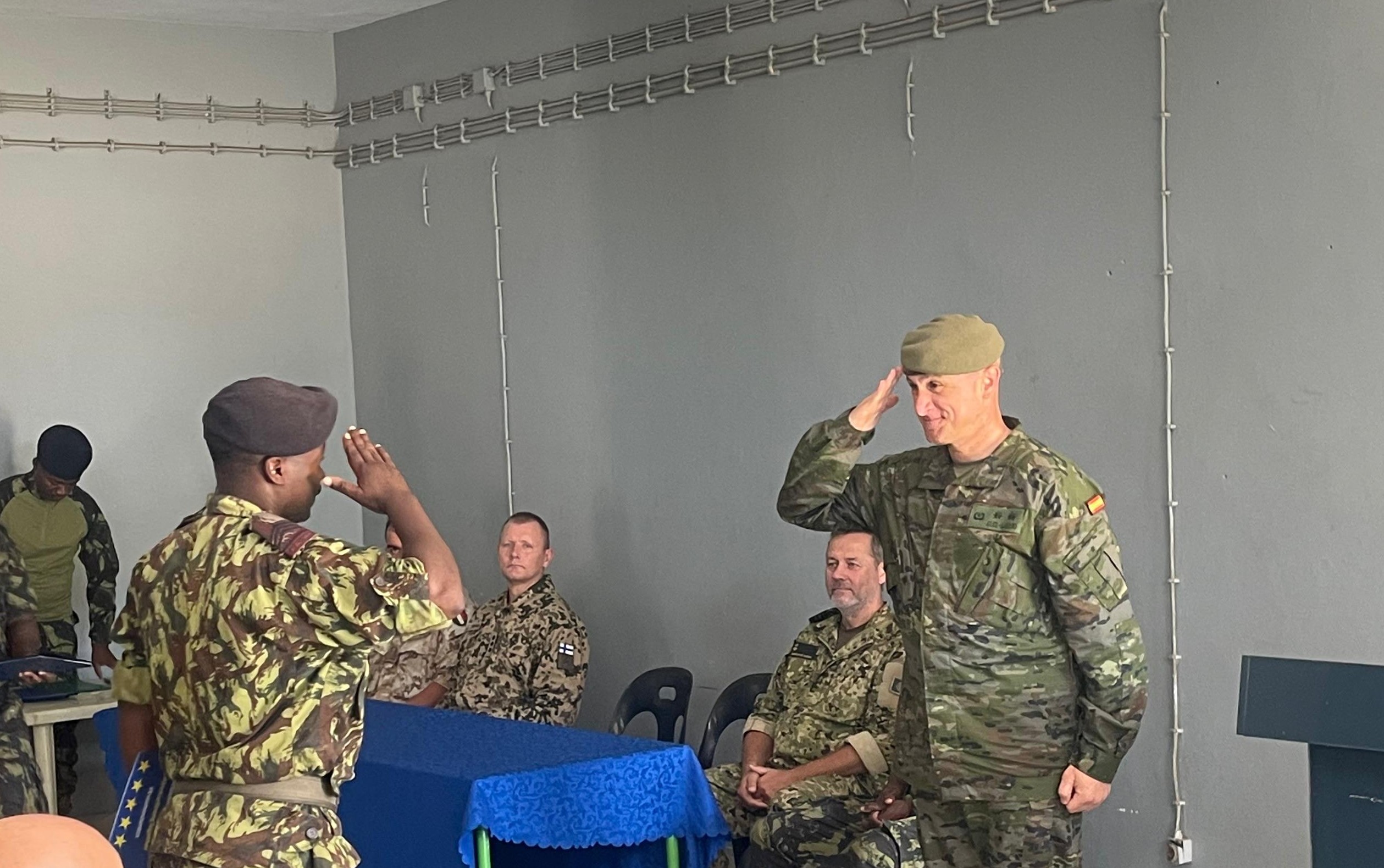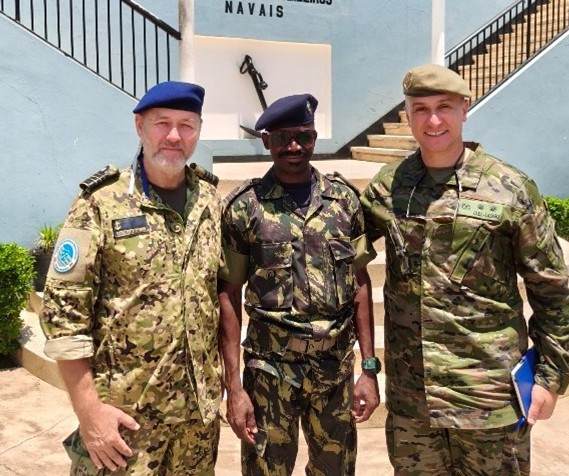

Lieutenant Colonel Bernardo González-Lázaro Sueiras: “Contributing to Mozambique's security means protecting our future in Spain.”
- Mental coaching, logistics, and the “value of presence”: this is the daily routine of Spanish officers, even during the Christmas season. With their effort and dedication, they are helping this African country strengthen its own security
Today, the European Union Military Assistance Mission (EUMAM) in Mozambique is the furthest south deployment of the Spanish Armed Forces, which have been present in the mission since its launch in 2021. At that time, the Council of the European Union approved a training mission—called EUTM Mozambique—with the aim of training Mozambican military personnel to protect the civilian population and restore security in the northern province of Cabo Delgado, where jihadist terrorism erupted with extreme violence in 2017.
Initially, EUTM was an effective tool for training Mozambican soldiers and supporting the peacebuilding process, humanitarian aid, and development cooperation. However, in 2024, the European Union's Political and Security Committee (PSC) increased the level of European commitment and ambition: it extended the mission until June 30, 2026, and, most importantly, agreed on a gradual transition to a model of assistance combining advice, mentoring, and specialized training.
In this new context, the mission was reconfigured as EUMAM Mozambique, where two Spanish officers are deployed at the headquarters in the capital Maputo, with critical responsibilities in planning and conducting advisory and training activities.
In this interview, Lieutenant Colonel Bernardo Gonzalez-Lázaro Sueiras, head of the Spanish military team, details the importance of this deployment and Spain's commitment to security far from our borders, based on the conviction that “we are here because defense is a public good that transcends borders.”
In 2021, the European Union approved this mission in Mozambique. What justifies a deployment so far from our European territory?
This is undoubtedly a key issue for understanding Europe's deployment and the legitimacy of our presence here. This mission stems from a request for assistance from the Mozambican government—formalized in September 2020—in response to the brutality of jihadist terrorism in the province of Cabo Delgado, which by then had already killed more than 2,000 people and was causing a devastating humanitarian crisis.
At the request of an ally and friend, the European Union decided to deploy this mission for three reasons: humanitarian solidarity, regional stability, and global security. We are here because defense is a public good that transcends borders. We cannot forget that the terrorism we are fighting here is a manifestation of the self-proclaimed Islamic State, known by its acronym ISCAP. If we allow this brutality to gain ground in Mozambique, it will grow and eventually affect Europe. Spain, as a committed partner, understood from the outset that our advanced security border also extends to the most northern region of Africa.
In 2024, they will become a comprehensive military assistance mission. What was behind this new challenge?
The change was not just a matter of acronyms; it was a necessary change in philosophy and, to a significant extent, the best example of the renewed commitment of Europe and Spain, which strongly supported this new approach. EUTM was a success story. From 2021 to 2024, in overall figures, we managed to train and equip eleven Quick Reaction Forces (QRF): some 1,700 elite Mozambican soldiers (Commandos and Marines) who are already fighting in the north with remarkable effectiveness.
However, we realized that training soldiers was not enough; we had to teach the Mozambican Armed Forces (FADM) how to sustain this effort over time. There is no point in having an elite unit if there is no logistics to support it. With this goal in mind, which is much more significant for strengthening the security sector, we transitioned to EUMAM, pivoting toward sustainability.
Now our goal is not only to teach how to fight, but also to teach how to organize, plan, and sustain. We have gone from being “instructors” to being strategic “mentors and advisors,” with the aim of making them autonomous. More specifically, and as a new challenge, we now also focus on the so-called Regeneration Cycle: supporting the FADM in the process of receiving units returning worn out from combat in Cabo Delgado, reorganizing them, re-equipping them, and retraining them so that they can return home in the best possible condition and with sufficient guarantees of effectiveness to protect the civilian population and end the terrorist threat.
All in all, and to be honest, we have made a lot of progress, but much work and effort still remains to be done. Our current mandate ends in June 2026, but both Portugal and Mozambique have already requested, at the last bilateral summit, that the mission should be extended until 2028. In my opinion, consolidating a modern and self-sufficient army takes a long time, and leaving prematurely would jeopardize everything we have achieved.
Spain, as in all European Union missions in Africa, has been a fundamental partner from the outset. What contribution are the two Spanish military personnel making to such an international EUMAM?
Although quantitatively we are a small contribution, our qualitative contribution is very important, as our bosses and colleagues, both in the mission and in Mozambique, recognize on a daily basis. Our positions are decisive in the “brain” of the mission, at its headquarters, from where all activities are planned and conducted.
My colleague and friend, Commander César Palomo Bernardos, heads the Logistics Section (J4) which, together with his team, advises units on the movement of equipment and supplies, vehicle and material maintenance, and financial support. In my case, I am the head of the Training and Mentoring Group (J7) and, therefore, I am responsible for designing and supervising all the training received by the FADM, from leadership courses for sergeants to the regeneration of combat units.
Without the J7 training plan and without the logistical support of the J4, the machinery would grind to a halt. That is why I say—with humility, but also with great pride—that Spain has made a profound mark on the effectiveness of this mission, without detracting from our colleagues from the other nations that make up the mission. At headquarters, under the command of Commodore César Pires Correia of Portugal, we work as a family of twelve nationalities—eleven from the EU, plus Serbia as a partner country—and each nation leads, as Spain does, a key area of the mission. The integration is total; there are no individual flags here, we are all “Team Europe.”
And how do they relate to the civilian population? How do they perceive this European and Spanish cooperation?
La relación con los mozambiqueños —desde las autoridades civiles y militares hasta los jóvenes de Maputo— es excelente y permanente, y su percepción es muy positiva. De hecho, nuestro lema "Estamos Juntos" lo resume todo. No vivimos en un búnker, interactuamos constantemente con nuestros anfitriones africanos. La población valora que no venimos a combatir por ellos, sino a ayudarles a protegerse a sí mismos.
On the other hand, we are also aware that they have many needs, which is why we carry out important civil-military cooperation (CIMIC) activities, with actions that touch people's hearts. On behalf of EUMAM, we have donated sports equipment to the “Casa do Gaiato” orphanage and collaborated with aid associations and the Nuestra Señora de los Desamparados nursing home. Seeing the smiles on their faces when we arrive with tangible aid, or simply with our presence, is sometimes the greatest reward of the day. Behind the uniform, they see people who genuinely care about the future of this country, and they do not hesitate to show us their affection.
Q: Finally, with Christmas just around the corner, what final message would you like to convey to your families and Spanish society as a whole about your participation in this EU mission?
To our families, as we tell them every day, we want to send a message of reassurance and, above all, gratitude. We are very aware that while we are in Mozambique, they are taking care of our home. Without a doubt, we miss them especially at Christmas, but I want them to know that we are fine, in a safe area and on a non-combat mission, meaning we are not engaged in combat. Your support and strength at home are what drive us to fulfill our mission here.
To Spanish society, I would like to say that the security and well-being we enjoy in Spain depend, to a large extent, on stability in regions such as this. This is a mission of the European Union, and our presence here demonstrates that Spain is a loyal, reliable, and committed partner. Our work is quiet but vital: by strengthening Mozambique's security sector, we are helping to build a shield against terrorism and instability, which also protects Europe. I am truly proud to represent our country by working for a safer world.
Fotos