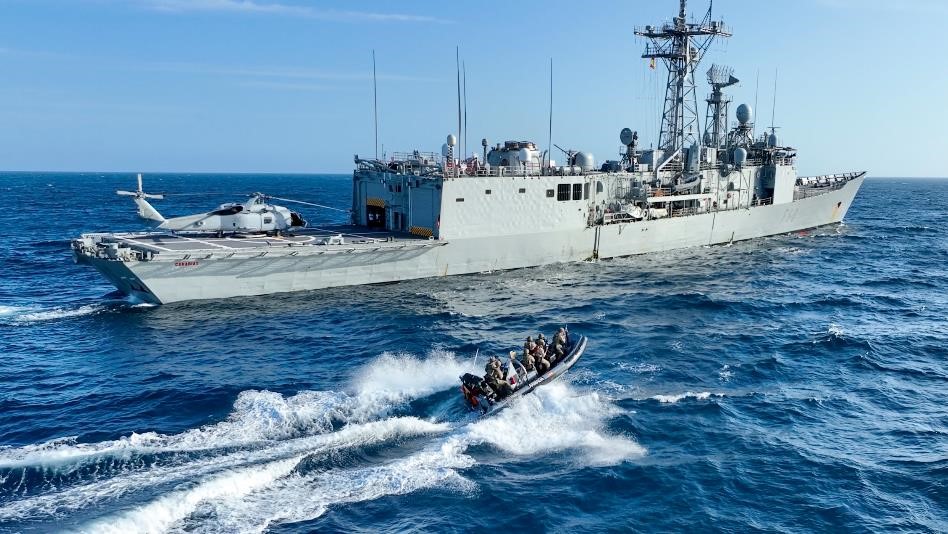


The frigate Canarias is sailing towards the Indian Ocean to join Operation Atalanta
- For more than four months, the ship will reinforce maritime security and surveillance in the area
The frigate F-86 Canarias has set sail and is heading for Djibouti, where it will take over from the frigate Victoria on the 20th. On this new mission, the Spanish vessel will sail under the operational control of the Operations Command.
After the handover, the ship, commanded by Commander Juan David García García, will join the European Union's Operation Atalanta, whose main objective is to combat piracy in the Gulf of Aden, the Somali Basin, and the Indian Ocean. In Rota, Cádiz
During this mission, the ship will contribute to protecting maritime traffic and maintaining stability in a region of particular strategic importance due to its trade routes and fishing grounds.
The naval unit has a crew of over 200 men and women. This includes a medical team with surgical capabilities, a Marine Corps security operations team, a Special Warfare Naval Forces unit and an airborne unit comprising an SH-60B helicopter and a Scan Eagle unmanned aircraft.
At the Port of Rota, the Admiral of the Fleet, Admiral José Enrique Delgado Roig, presided over the farewell ceremony for Canarias and her crew. During the event, he encouraged them to further strengthen their cohesion, discipline, and comradeship, while also underscoring “the importance of this type of international mission, as well as the firm commitment demonstrated by both the Spanish Navy and Spain, in cooperation with the rest of the countries of the European Union.”
Frigate Canarias
The frigate Canarias, the sixth unit of the Santa María class, was built by Empresa Nacional Bazán (currently Navantia) and delivered to the Navy in 1994. Measuring 138 metres in length and displacing 3,900 tonnes, the frigate is equipped with sensors and weapon systems that enable it to conduct air defence, anti-submarine warfare, maritime surveillance and traffic control missions in areas of interest.
This will be the sixth time that the frigate Canarias has joined Operation Atalanta since December 2008, when this first European Union naval mission was launched under the Common Security and Defense Policy. Since then, Spain has continuously participated in the operation and, since 2019, has assumed command of it from its headquarters in Rota.
Throughout its operational life, the frigate Canarias has participated in various international operations and deployments within the framework of NATO and the European Union, as well as in permanent naval groupings and multinational exercises, during which it has accumulated solid experience in surveillance missions, naval presence, and international cooperation.
Operation EUNAVFOR Atalanta
Operation Atalanta is the result of a series of United Nations resolutions adopted following the increase in acts of piracy in the Indian Ocean from 2005 onwards. With the firm support of Spain, it became the first naval operation of the European Union conducted under the Common Security and Defence Policy. At the end of 2024, the EU Council approved the extension of the operation’s mandate until 28 February 2027. Over time and through successive mandates the area of operations has been expanded and currently includes the Gulf of Aden and neighbouring countries, including the port and city of Muscat (Oman), the Somali Basin, the Red Sea, and the Gulfs of Suez and Aqaba.
Spain currently contributes to Operation EUNAVFOR Atalanta with around 350 military personnel and the following main assets: the frigate Victoria, which has a helicopter and a special operations team on board and a DAT Orion maritime reconnaissance and surveillance aircraft, which is currently stationed in Spain due to the complexity of operating during the monsoon season.
Fotos