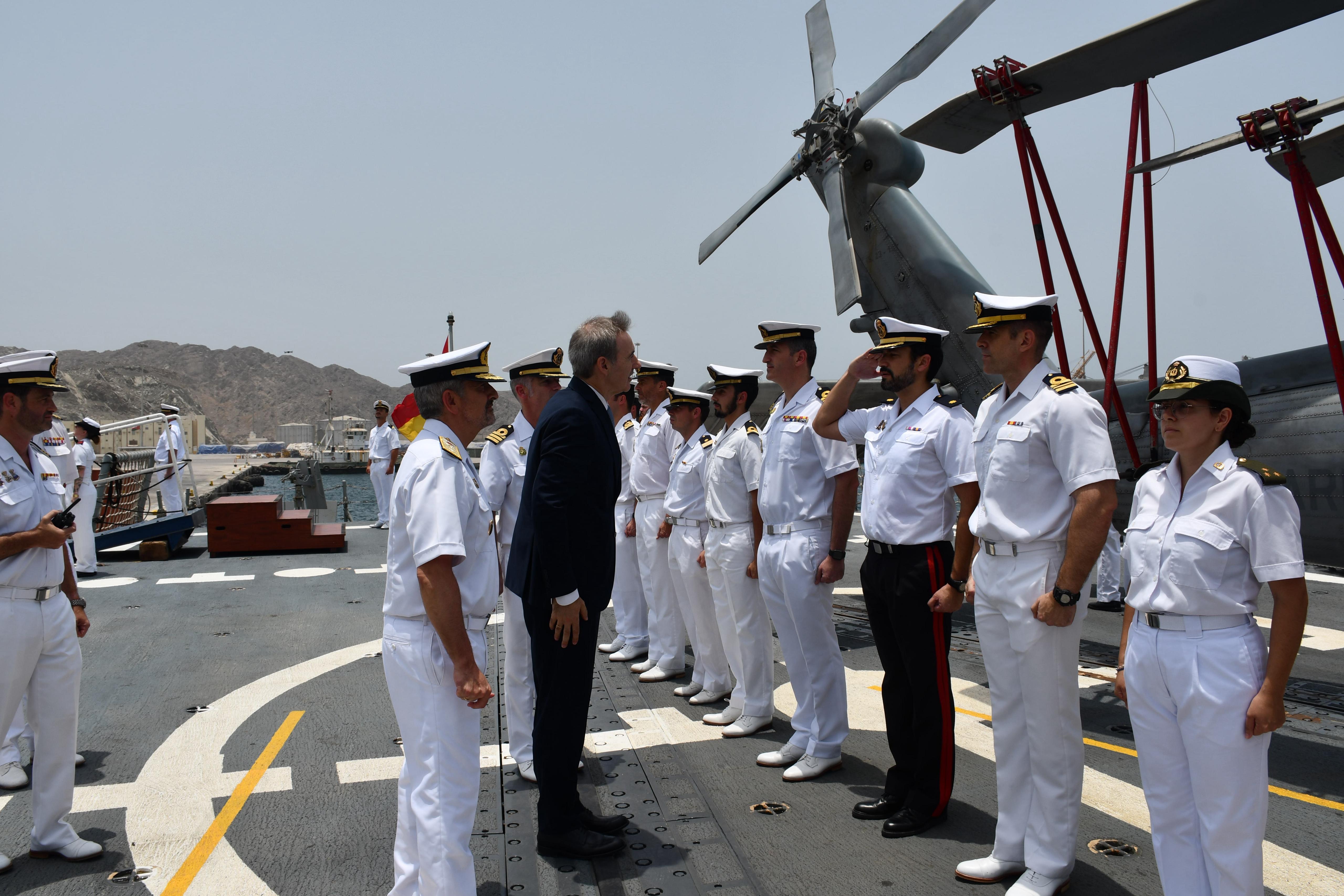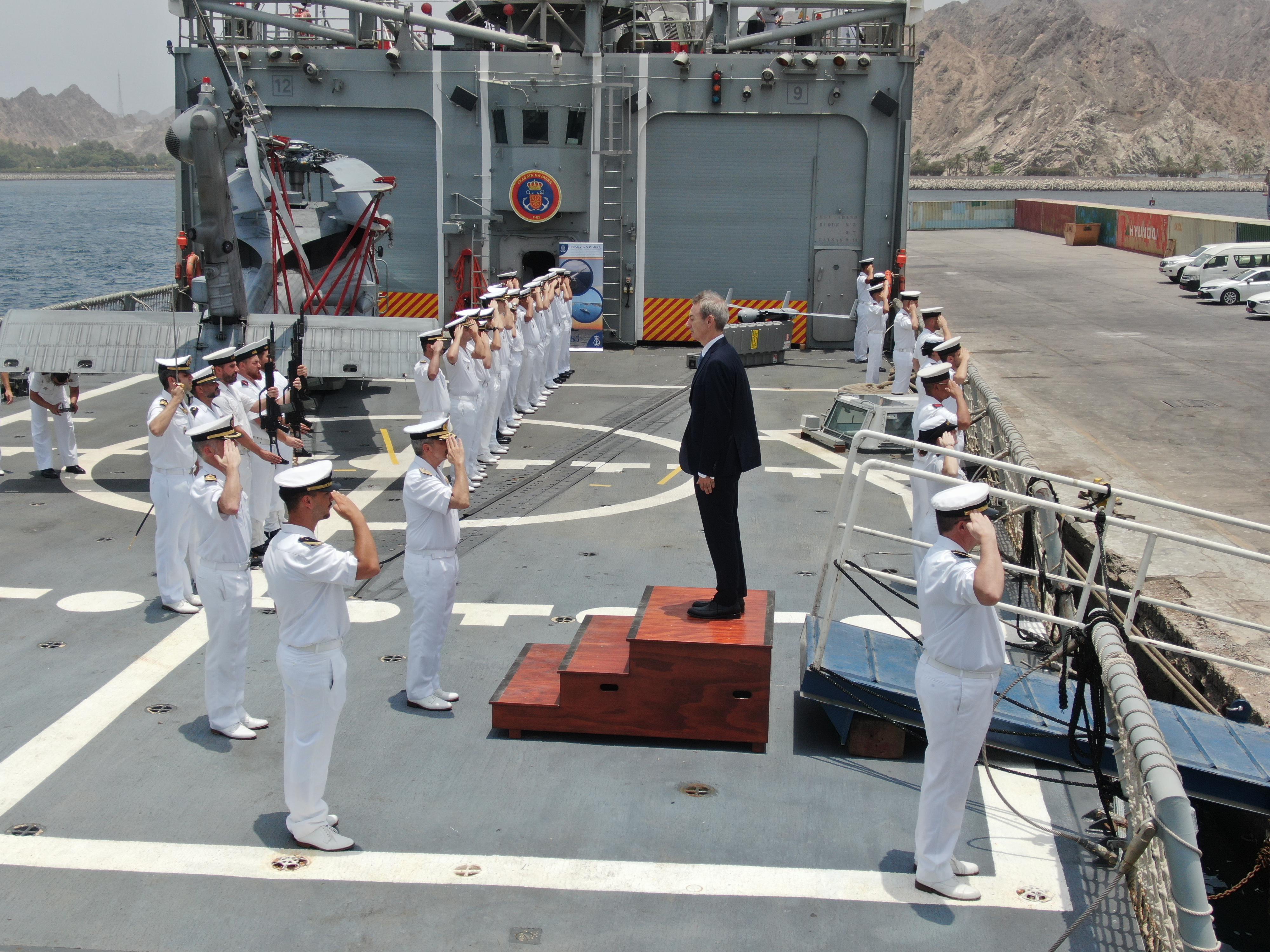


Frigate ‘Navarra’ welcomes onboard Spanish Ambassador to Oman during port of call at Mascate
- Ship is currently on counter-piracy patrol in the Indian Ocean, in the framework of an operation of the European Union
Frigate ‘Navarra’, deployed as the flagship of Operation ‘Atalanta’, received a visit from the Spanish Ambassador to Oman, Francisco Javier De Isturiz Simonet. Upon arrival, the diplomat was welcomed at the gangway by the Operation's Force Commander, Rear Admiral Francisco Javier Vázquez Sanz, and by the Commanding Officer of the vessel, Commander Álvaro Huelin Gan.
During the visit, a representation of the ‘Navarra’ crew - led by the Commanding Officer - briefed the ambassador on the frigate’s capabilities to accomplish its mission in the Indian Ocean. In addition, he held discussions with Rear Admiral Vázquez on the current situation in the area and the progress of the mission. They also spoke about the strong relations between Spain and the European Union with the Sultanate of Oman, as well as their shared interests in regional security.
Furthermore, during the port call in the Omani capital, the Force Commander of Operation Atalanta - whose Force Headquarters (FHQ) is embarked on board ‘Navarra’ - visited the Omani Maritime Security Centre (MSC), where he held a meeting with its Director to address maritime security issues in the Indian Ocean. They also discussed the Centre’s tasks and its cooperation with other nations and naval forces, while highlighting the excellent collaboration and mutual support between the Royal Navy of Oman and Operation ‘Atalanta’.
‘Navarra’ in ‘Atalanta’
Frigate ‘Navarra’ joined Operation ‘Atalanta’ last June 11th, after relieving Frigate ‘Reina Sofía’ in Djibouti. As a part of the 41st Spanish Navy’s Escort Squadron, the frigate ‘Navarra’ is homeported at Rota Naval Base, Cádiz. Last year, she marked 30 years of service with the Spanish Navy, and this is her sixth deployment in support of the European Union’s counter-piracy Operation ‘Atalanta’.
On board are more than 220 personnel, including an embarked Air Unit (featuring an SH-68 helicopter and a SCAN EAGLE unmanned aerial vehicle; a Marine Corps Force Protection Team and members of the operation’s staff under the command of Rear Admiral Vázquez.
Operation Atalanta stands as a result of a series of United Nations Security Council Resolutions in response to the sharp increase in piracy in the Indian Ocean from 2005 onwards. With strong support from Spain, the mission became -by decision of the EU Council in November 2008- the first-ever naval operation launched under the framework of the Common Security and Defence Policy (PCSD,in Spanish).
In late 2024, the EU Council approved an extension of the mandate until 28 February 2027, reflecting both the operation’s achievements and the challenges that remain. Over time, the Area of Operations has been expanded through successive mandates and currently covers the Gulf of Aden and neighbouring countries, including the port and city of Muscat (Oman), the Somali Basin, the Red Sea, and the Gulfs of Suez and Aqaba.
Participation of Spain in ‘Atalanta’
Spain is currently contributing to Operation ‘Atalanta’ with the following assets and units:
Operation ‘Atalanta’ Headquarter, at the Rota Naval Base.
Operation ‘Atalanta’ Force Headquarter, as rotationally assigned.
A frigate/warship.
A Joint Embarked Aviation Unit (UNAEMB, in Spanish), composed of helicopter and UAV ScanEagle.
An Embarked Special Operations Team, only during inter-monsoon periods; A Security Operational Team (EOS, in Spanish) during the rest of the year.
A maritime patrol aircraft (DAT ‘Orión’) in Djibouti during inter-monsoon periods.
Liaison Offices located in Mogadishu (Somalia), Manama (Bahrain), Brussels (Belgium) and Port Victoria (Seychelles).
A Logistic Operation Support Unit deployed at Djibouti (Djibouti).
As proof of our commitment to the security in the area, Spain has been the one and only member nation in the European Union to maintain uninterrupted participation in Operation ‘Atalanta’ since its launch.
Fotos