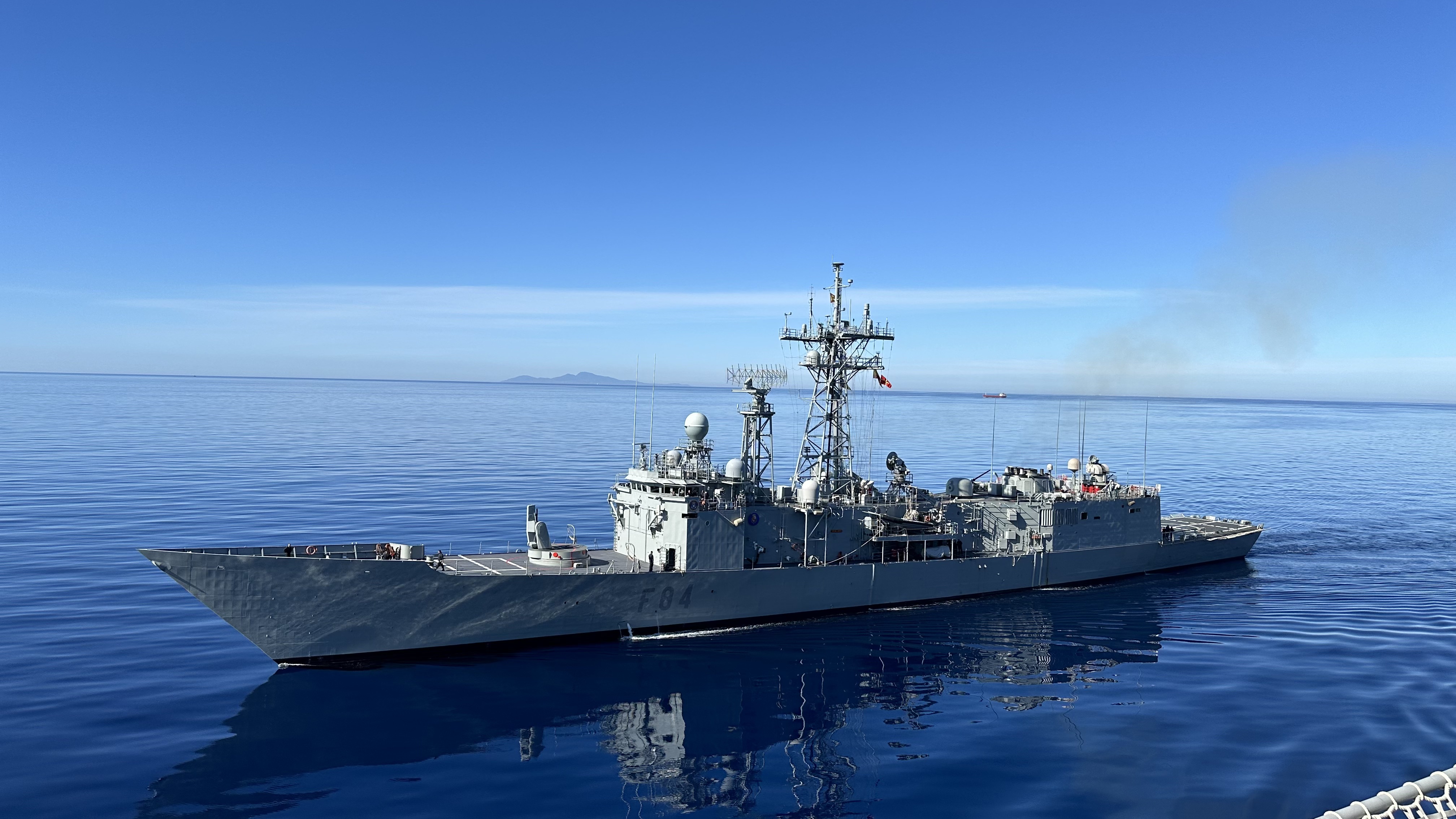


The Desired Effect of the Frigate 'Reina Sofía' in Operation Atalanta is to Assist Somalia in Confronting Piracy Autonomously
- With these words, Frigate Captain Salvador Moreno Regil, Commanding Officer of the frigate 'Reina Sofía', encapsulates the vessel's mission
In late 2008, the European Union Council approved the establishment of the EUNAVFOR 'Atalanta' maritime military operation to contribute to the deterrence and prevention of piracy and other illicit acts off the coast of Somalia. Over time, the EUNAVFOR mandate has adapted to reflect the evolving situation in the region and the increased presence of the international community, transforming the operation into a provider of maritime security in the north-western Indian Ocean.
In this context, Spain has consistently contributed marine assets to collaborate in regional stability in a strategically vital area for national interests. Currently, the frigate 'Reina Sofía' participates in this operation, and its commander, Frigate Captain Salvador Moreno Regil, provides an assessment of his experience in the mission.
Operation 'Atalanta' approved in 2008, EU Operational Headquarters assumes command in 2019 – What does this leadership entail?
Spain hosts the Operational Headquarters (OHQ) of Operation 'Atalanta', which is highly significant for our country's leadership in the international arena. From Rota, under the command of a Spanish Vice Admiral, strategic command and operational planning are exercised, along with the direction of all deployed units. This command demonstrates Spain's commitment to the security of strategic maritime routes for global trade, the protection of World Food Programme (WFP) vessels, and stability in the Horn of Africa. Undoubtedly, 'Atalanta' leadership enhances the prestige of our Armed Forces, as well as strengthening the training and international experience of Spanish military personnel. Additionally, 'Atalanta' is an excellent opportunity to showcase the high capabilities of national naval units and indigenous assets (aircraft, drones, etc.).
What are the main tasks and missions of the 'Reina Sofía' Frigate in Atalanta?
Our tasks can be divided into four main groups: ensuring freedom of navigation in the western Indian Ocean, a complex, unstable, and vast area—several 'Mediterranean seas'; protecting WFP vessels, which perform a very necessary task; supporting regional forces that may ensure, in the future and by themselves, freedom of navigation; and the most well-known of our tasks: deterrence, prevention, and, if necessary, action against piracy in the area.
The way we carry out these tasks from the ship is very varied, and it must be emphasized that we perform our tasks in a small space of only 140 meters where 226 people live, and we are self-sustaining along the endless coast of Somalia. This requires us to show our presence at key points; and when an alert indicates that a piracy act has occurred, all—the frigate, its helicopter, its drone, its special operations team, and most importantly, its crew—are permanently prepared to act and liberate the attacked vessel. And all this without forgetting that the desired effect of the 'Reina Sofía' frigate in Atalanta is to assist Somalia in confronting piracy autonomously.
Spain contributes to Operation 'Atalanta' Not only with its Frigate but also with the 'Orión' Detachment—How do they complement each other?
Here, again, the immense size of the operational area is key. Covering the entire area with a single ship is not possible, and having a maritime surveillance aircraft significantly increases capabilities, especially when searching for a pirate vessel in the shortest time possible. Once located by the aircraft, the frigate can focus and make its search much more effective, thus reaching the location where action is needed as quickly as possible.
During navigation,they conduct military cooperation activities with regional navies
As noted, one of the major tasks of the frigate and the operation itself is to create a regional maritime security architecture capable of providing, autonomously, security and freedom of navigation in the area. Therefore, when we enter one of the region's ports, we conduct training known as Local Maritime Capacity Building, aimed at sharing our procedures to increase maritime security. We also carry out these activities with the Somali federal forces during the patrols we conduct off the country's coasts.
In addition to Operation 'Atalanta', other Naval Forces operate in this area—How do they relate and coordinate?
Indeed, in addition to European Union forces, ships from friendly states operate independently or integrated into various International Coalitions. All these actors have different approaches, from combating piracy, illicit trafficking, or transnational terrorism to escorting vulnerable civilian vessels, among other objectives. Although each of us develops our tasks, it is essential to obtain synergies, at least in the exchange of information that may serve the others. In this sea of operations and naval forces, 'Atalanta' is a prestigious operation that addresses piracy comprehensively and with tangible results; moreover, it operates closest to the Somali coast, providing highly useful information for all.
Finally, in these 16 years of deployment, what have been the main achievements of the mission?
Undoubtedly, the main achievement has been ensuring maritime security in the Horn of Africa, through which one of the world's main communication and commercial routes passes. However, it is important to emphasize that piracy was defeated but has not disappeared and can develop at any time, as the major structural problem that gave rise to the piracy phenomenon between 2008 and 2012 remains intact: Somalia still lacks the capacity to control its own territory and maritime sovereign space and continues to suffer threats such as jihadist terrorism, endemic poverty, or drought, among others.
In the last 18 months, there have been acts of piracy, which we can still consider isolated events but are a real indicator that the phenomenon remains present. Therefore, to prevent this threat from increasing, Atalanta vessels remain highly committed to the Somali Government, which authorizes us to navigate its territorial waters, and also with local leaders. Moreover, in our continuous interaction with local representatives, we perceive that the vast majority reject piracy. All this allows us to have a comprehensive view of the situation. From our respect and commitment to Somalia and local and regional development, Operation 'Atalanta' remains very necessary, both to maintain the fight against piracy and to support, with its capabilities, the development of the different states in the region.
Fotos