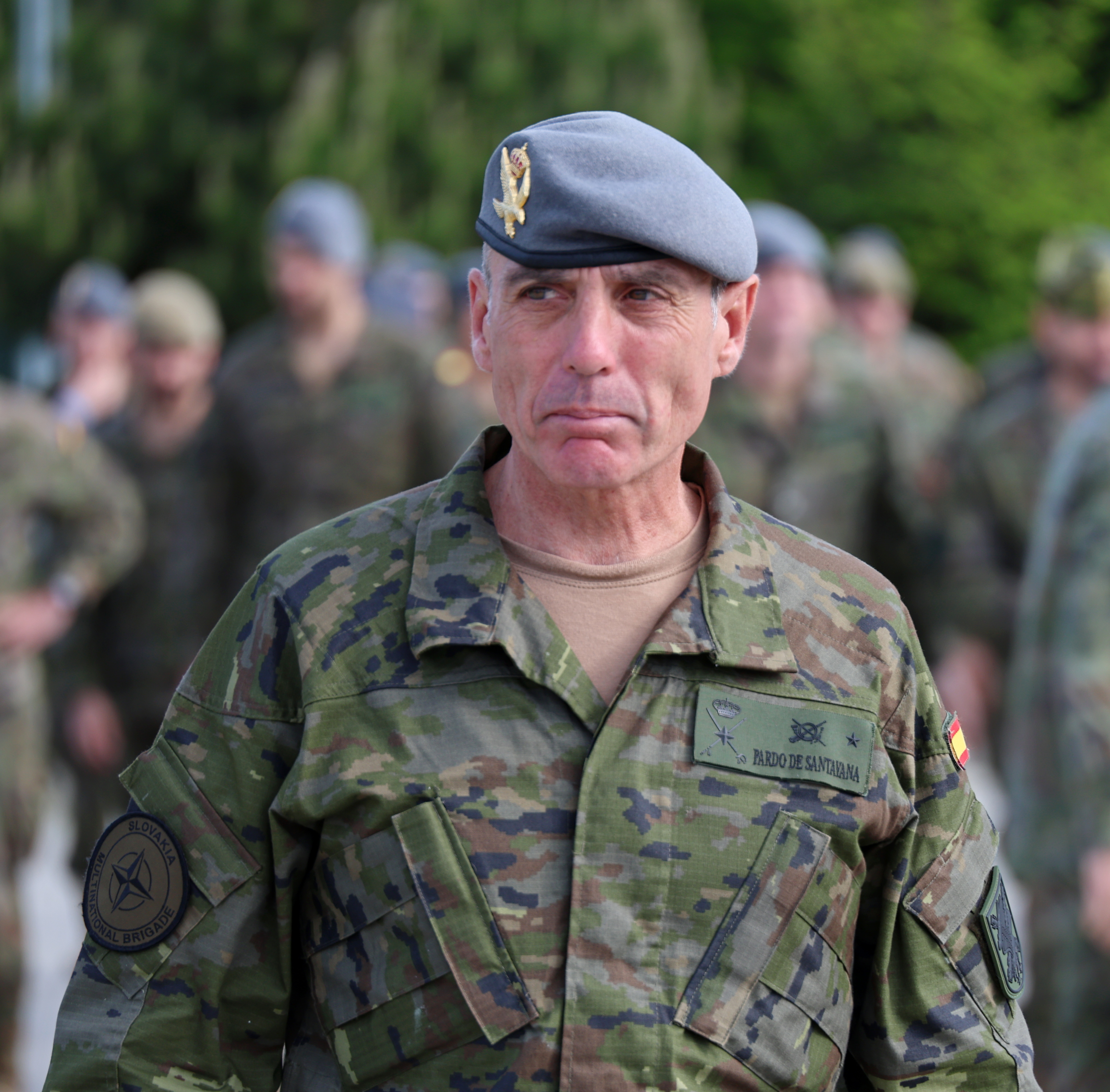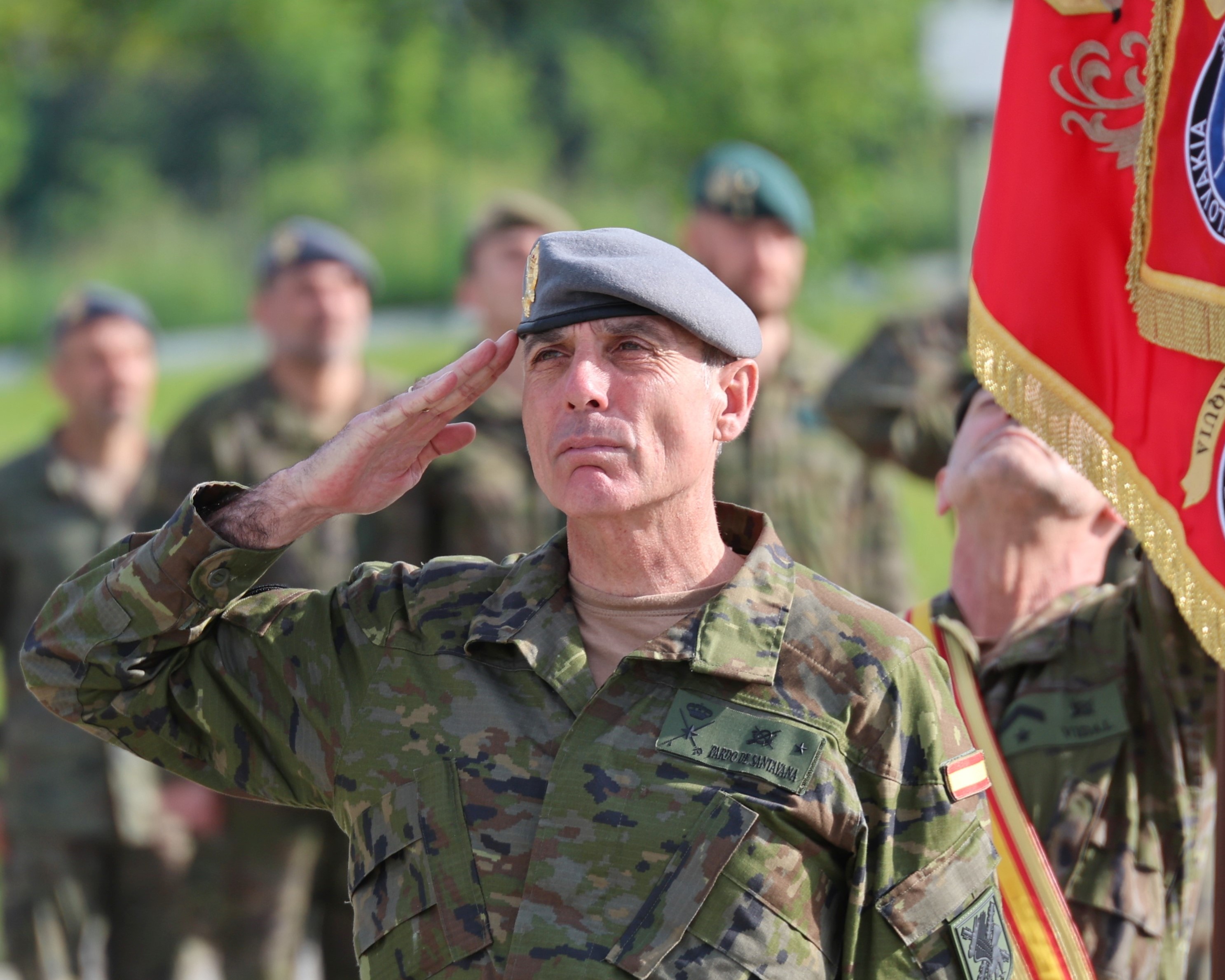


‘Strong Lineage 25 is a huge challenge, but also a great opportunity to improve our capabilities and operability,’ says General Pardo de Santayana
- The commanding general of BRILAT has travelled to Slovakia to participate in the validation of the NATO Multinational Brigade led by Spain and to verify the high level of integration of its soldiers in the international deployment on the eastern flank of the Alliance
In November 2023, the Brigade ‘Galicia’ VII - BRILAT was designated to participate in the ‘Strong Cohesion’ 23, a strategic projection exercise of a Tactical Group to Slovakia under the command of the Colonel of the Regiment ‘Isabel la Católica’ nº 29. At that time, the decision was announced to deploy a Spanish contingent to Lešť, which began arriving in Slovakia in January 2024. In July of the same year, Spain became a framework nation for the Multinational Brigade in Slovakia - an extraordinary milestone that underlines our commitment to protecting the eastern flank.
Now, the third contingent deployed to Lest, also based at BRILAT, faces the operational activity Strong Lineage 25, which will validate the NATO Multinational Battle Group deployed to Slovakia's brigade level. In this interview, Brigadier General Alfonso Pardo de Santayana y Galbis reflects on the enormous challenge this effort has meant for all the Armed Forces and for Spain, whose ‘weight as a nation on the international stage is measured by the effort it is capable of making for the benefit of the whole’.
Currently, the Brigada Galicia VII - BRILAT has been the base unit of the contingent deployed in Lešť since December 2024. How did we get here and what does it mean for you as head of BRILAT?
In January 2024, a group under the command of Colonel Andrés Alvarado, head of the 29th Regiment, began its deployment in Slovakia, and its main objective was to create the conditions to take over on 1 July 2024 the functions as Framework Nation, when it relieved the Czech Republic of that responsibility. After a rotation led by the Parachute Brigade, the BRILAT was once again the base unit in December 2024, this time under the command of Colonel Jesús Martínez Victoria of the ‘Príncipe’ Regiment No. 3, who -on 19 June- will be relieved by a new BRILAT contingent under the command of Colonel Ángel Espiga, head of the ‘Farnesio’ Regiment No. 12.
Undoubtedly, the deployment in Slovakia has been a very demanding effort that has put us to the test. I would like to stress that a nation's weight on the international stage is measured by the effort it is capable of making for the benefit of the whole; and, among the thirty-two member states of the Alliance, Spain is - for almost a year now - one of the countries leading a Battle Group with the capacity to grow to Brigade level in eight nations on the eastern flank of Europe, specifically in Slovakia. As Brigade Commander, I have noticed the professional and personal quality of the men and women of BRILAT whom I have asked for initiative to ‘attack’ problems with resolve and judgement, imagination to identify new ways of doing things and total dedication to the mission; and they have always answered with joy, confidence and competence. I thank God every day for being able to serve these soldiers together.
The Strong Lineage 25 operational activity will validate the Spanish-led NATO Multinational Battle Group Slovakia's upgrade to brigade status. How has BRILAT prepared to take on this challenge?
Well, from the beginning I approached the challenge as a great opportunity. An opportunity to grow, to study the operational procedures of the most current conflicts and adapt ourselves to present credible and modern brigade capabilities. We were determined to build on this momentum because Strong Lineage 25 is certainly a huge challenge, but it is also a great opportunity to improve our capabilities and operability in the long term. And we have prepared consciously: first, by being very critical of our starting point; second, by studying what is going on in the world; and third, by raising our level of ambition to try to have the capabilities we believe are needed.
On the other hand, we also had the good fortune to lead, between May and December 2024, the EUMAM Ukraine operation in Spain, the objective of which is to train Ukrainian military personnel in our country. This experience brought us face to face with the harsh reality of a war that is leaving us with many lessons and experiences, both operational and personal.
Other allied nations participate in the Brigade, how do they coordinate and integrate to fulfil the mission on the eastern flank?
A brigade-type unit is a large unit that integrates manoeuvre units, infantry and cavalry battalions and groups, combat support units such as artillery and engineers, and logistic support units. This integration is achieved through a robust command and control system, supported by command and information systems (CIS) that guarantee permanent and secure liaison with all my units and, upwards, with NATO's CIS systems. It should be stressed that Spain is one of the few countries with a command and control system capable of federating, of integrating, with NATO's secure communications systems through our NRDC-ESP headquarters in Bétera, which belongs to the Alliance's force structure.
But, above all, this integration is achieved by using the same operating procedures, that is, the same way of doing things in all areas. The integration of these units from other NATO nations is achieved by sharing these procedures, always aligned with Alliance standards, and by training together to achieve maximum effectiveness and the best possible interoperability.
In Slovakia, BRILAT has proven itself ready to lead and build a multinational brigade. What are the main challenges for the future?
The operating environment is complex and highly dynamic. This month starts the deployment of the SVK IV contingent, which will continue to make progress in multinational integration, always very aware of the situation. We will have to re-certify the deployed Battle Group, passing a demanding NATO Combat Ready Evaluation (CREVAL). As a framework nation, it will be responsible for continuing to lead all necessary logistical activities and arrangements, not only for Spanish units, but for all nations deploying to Lest, Slovakia, Slovenia, the Czech Republic, Portugal and Romania. And, finally, it should continue to work to create ties with the local population, strengthening the necessary cohesion within the Alliance.
In this edition of Operation Strong Lineage 25 we have deployed enough brigade capabilities to validate the concept, but not all. From now on, each contingent will add to the efforts towards the goal of being able to deploy the multinational brigade with full capabilities by 2027.
In a few days, HM King Felipe VI will witness in Slovakia this operational activity of great importance for NATO and for Spain.
The presence among us of His Majesty the King is an accolade that strengthens us and fills us with pride and also a great responsibility, which will allow us to show what we are capable of and what his soldiers are doing every day in this country, Spain's leadership of one of the eight multinational Battle Groups deployed on the Alliance's eastern flank is a recognition by NATO of the high level of preparation, professionalism and capability of the Spanish armed forces, and Spain's first soldier, His Majesty the King, will be able to feel it.
Finally, in February 2023, you took over as Brigade Commander, what are the strategic lines of your command?
As a colonel, I was lucky enough to command one of the regiments of the ‘Galicia’ brigade, the ‘Príncipe’ regiment No. 3, based in Siero (Asturias). This allowed me to get to know the BRILAT, and when I took command in February 2023, I knew what I wanted and what I could do.
When we in the military refer to how we want to do things, we call it our ‘purpose’. Well, my purpose in taking over the brigade, which has not changed over the years, has been to put the soldier, the fighter, at the centre. He is the brigade's fighting power; a soldier trained in values, who knows his equipment, his material, who is in perfect physical condition, who is an attacker, an expert marksman and who masters his tactical position.
And in a critically aware unit, what is not evaluated is not improved. We have set up structures to observe, analyse and improve our procedures. In addition, we look around a lot with a vocation to learn and adapt - with a lot of flexibility - to the needs of a very changing and demanding operating environment. And all this, without fear of error, giving maximum initiative to each subordinate, not without first ensuring that he or she fully understands where we are going.
Fotos