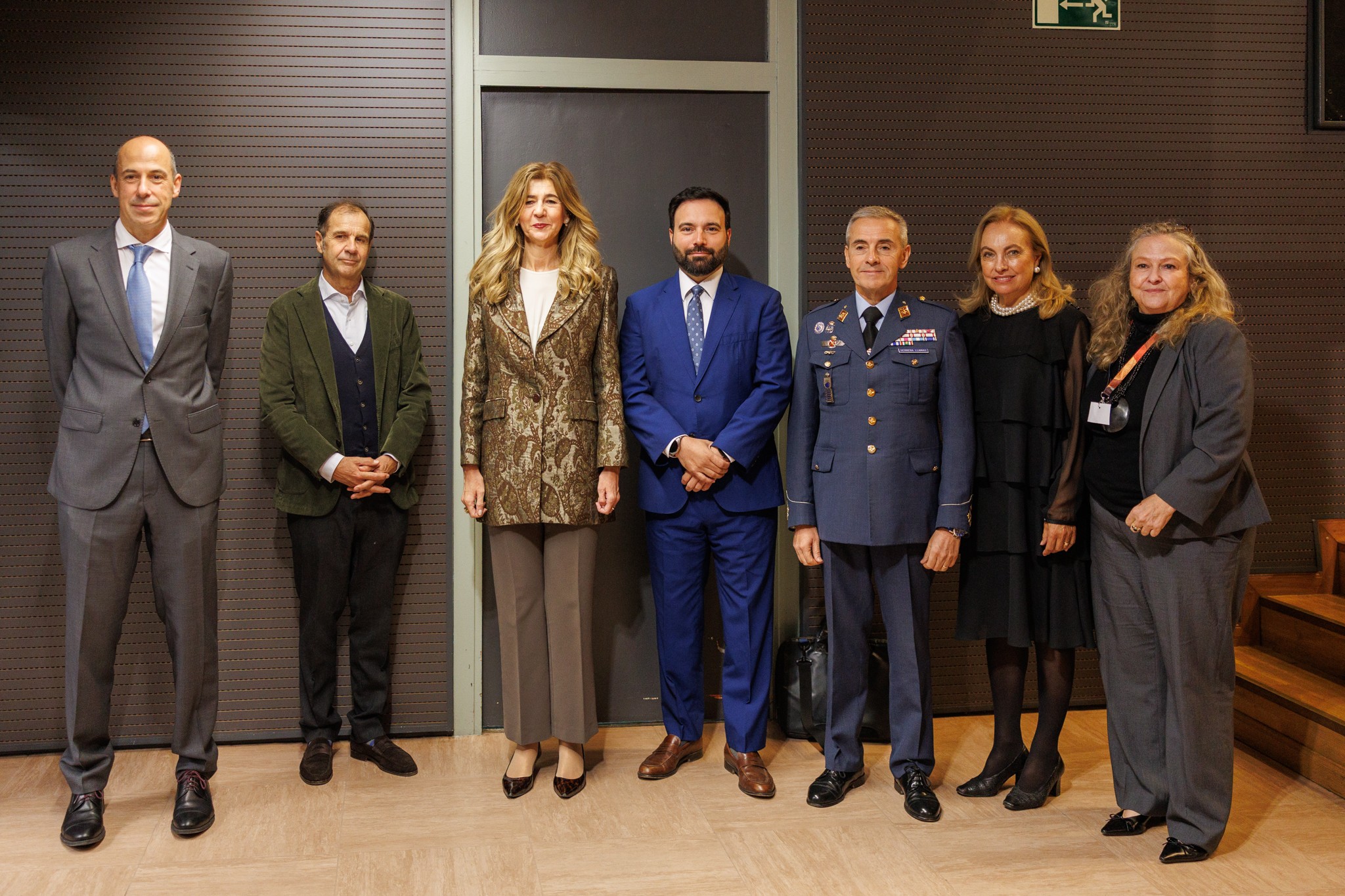


The chief joint of Defence attends the opening of the conference on generative AI organised by the Complutense University
Lieutenant General Herrera has stated that artificial intelligence within the Armed Forces has the potential to redefine the way in which security and defence challenges are addressed in the 21st century
The Chief joint of Defence (JEMACON), Lieutenant General José Antonio Herrera Llamas, took part in the opening ceremony of the ‘2nd Congress on Generative AI: Radical Transformation of Science, Communication and Culture’, organised by the Complutense University of Madrid (UCM) and held at the Faculty of Information Sciences.
At this event, experts in artificial intelligence will discuss its impact on civil security and cyber-attacks, emphasising the importance of its application in the field of defence.
In his speech, JEMACON pointed out that AI in the Armed Forces has the potential to redefine the way in which security challenges are addressed in the 21st century. He added that this is particularly evident in cyber defence, as AI-based systems must be capable of anticipating vulnerabilities and reducing exposure to them before an attack occurs
Lieutenant-General Herrera also explained that the implementation of AI in the defence sector presents complex challenges that must be addressed carefully and rigorously, whilst upholding ethical and legal standards in a range of areas, such as cyber security and cyber defence, logistics, intelligence, surveillance and reconnaissance, big data analysis, process optimisation, the use of weapons and decision-making.
Furthermore, he has argued that Artificial Intelligence must be trained and supervised by people. Its military application leads to a considerable increase in the combatant’s cognitive capacity, but always on the premise that AI supports humans rather than replacing them. It is therefore not an end in itself, but a means to an end.
At the opening ceremony, JEMACON was joined by the UCM Vice-Chancellor for International Relations, Cooperation and Volunteering, María del Rosario Cristóbal Roncero; the Councillor for Innovation and Entrepreneurship, Ángel Niño; the Dean of the Faculty of Information Sciences, Ángel Luis Rubio Moraga; the Dean of the Faculty of Computer Science, José Luis Risco Martín; and the conference director and principal investigator of the Transparency, Good Governance and Communication group, María del Pilar Cousido González.
Over the course of the two-day conference, eight round-table discussions will be held, featuring experts from institutions, security and technology companies, and academics from various universities around the world. These discussions will address issues such as accountability in the use of AI and the need for international regulation; the threat of losing control over it; the aim of achieving an improvable superintelligence; and the impact on employment and data ethics.
Fotos