

The Joint Cyberspace Command identifies AI governance and control as strategic priorities in cyber defense
The Command’s institutional relations adviser is taking part in the conference ‘The future of AI has rules: How to turn regulatory compliance into a business advantage’
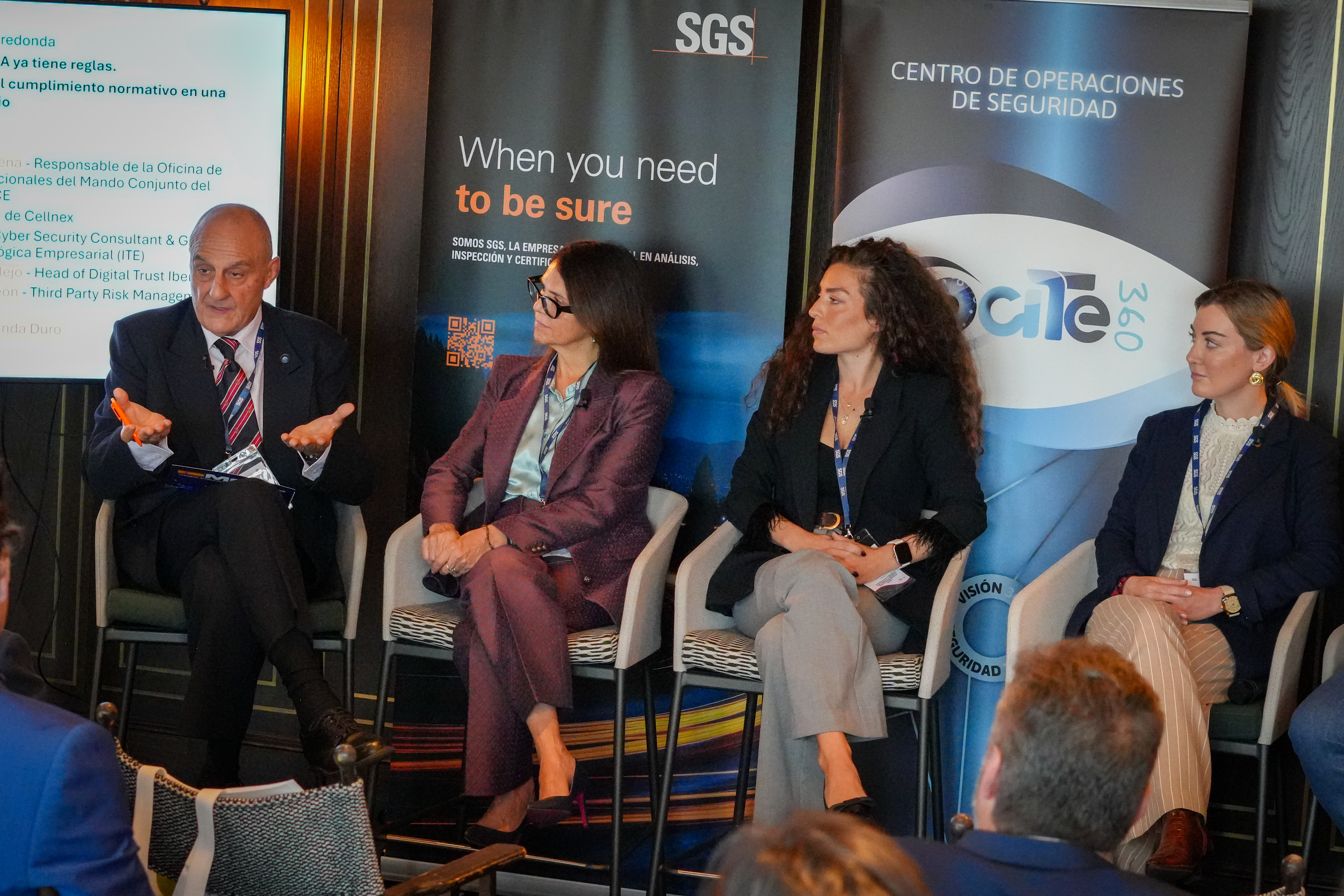
Enrique Pérez de Tena, Institutional Relations Adviser at the Joint Cyberspace Command (MCCE), took part in the conference entitled ‘The future of AI already has rules. How to turn regulatory compliance into a business advantage’, organised at the Club Financiero Génova in Madrid by SGS and Integración Tecnológica Empresarial (ITE).
During his speech, Pérez de Tena pointed out that, from a cyber-defence perspective, Spain’s priority with regard to artificial intelligence must be to establish a layer of governance and an institutional control framework. He also emphasised that this technology needs to be fed with high-quality data and requires the traceability of its decisions to be guaranteed, so as to understand what the system is doing and why it provides each response.
He also emphasised that companies and public bodies must overcome their fear of change. “AI is here to stay and we cannot ignore it: we must use it, but in a controlled manner,” Pérez de Tena asserted.
In addition, the MCCE representative also pointed out that artificial intelligence is not suitable for all tasks, but rather serves as a complementary tool within the Armed Forces. In this regard, he explained that the key lies in applying specific algorithms designed for particular functions, whilst maintaining precision, security and oversight within the operational environment at all times.
Pérez de Tena shared the stage with Laura Parra (Cellnex), Ramón Monleón (Orange Spain), Alma Villanueva (ITE) and Lucile Corrales Vallejo (SGS), with whom he analysed the direct implications of the new regulatory framework for artificial intelligence. Throughout the debate, the participants addressed the challenges and methodological requirements posed by the use of this technology in the operational sphere of cyber defence.
Fotos