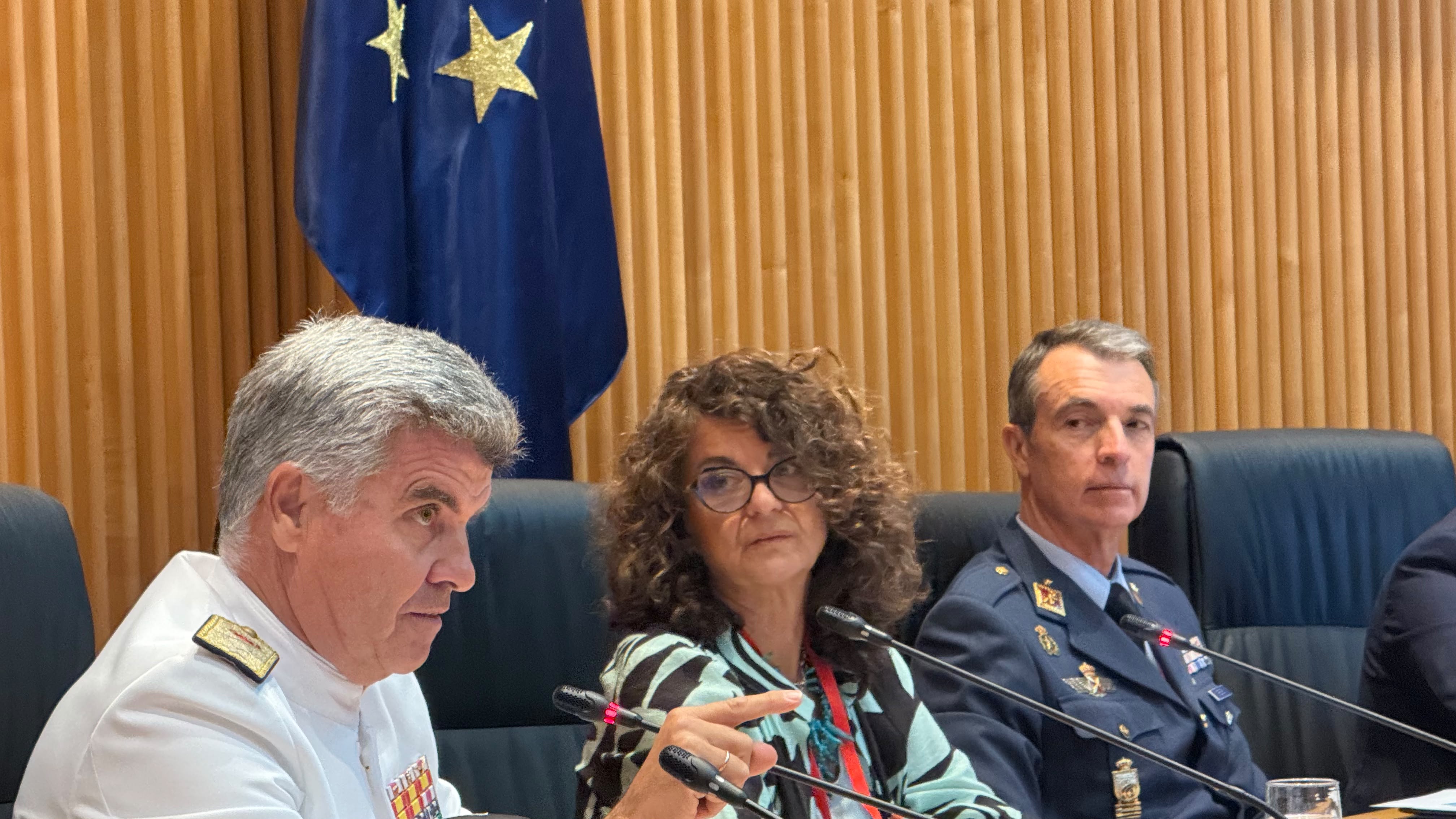


The commander of the Joint Cyber Command speaks at the European Interparliamentary Space Lecture
Vice-Admiral Roca took part in the plenary session, held in the Congress of Deputies, to discuss the resilience of strategic satellite infrastructure and secure communications for the future
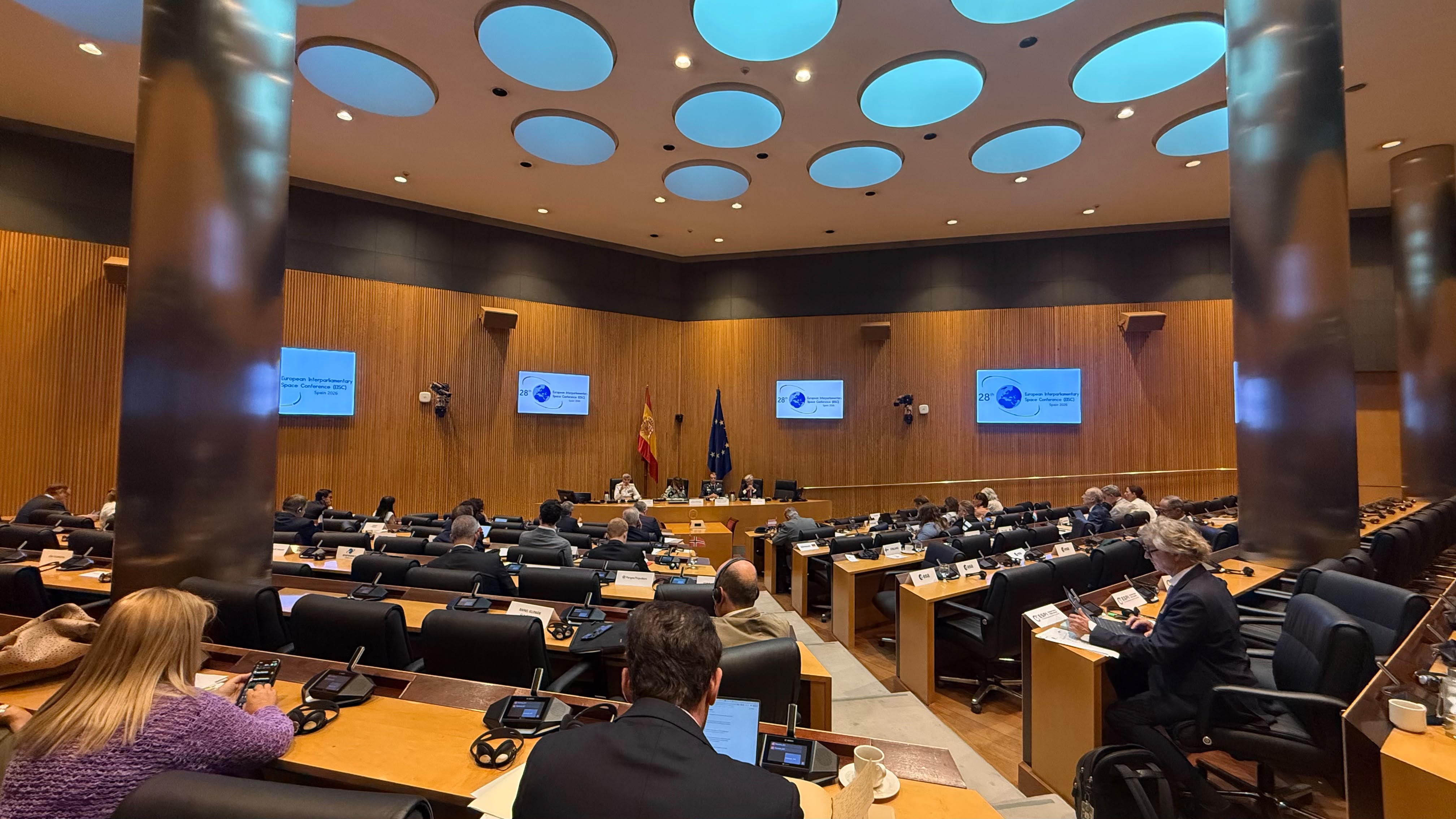
The Joint Cyberspace Command (MCCE) attended the plenary session of the 28th European Interparliamentary Space Conference (EISC), held in the Ernest Lluch Chamber of the Congress of Deputies in Madrid.
Under the theme ‘Space as a shared strategic asset’, this high-level inter-parliamentary forum has brought together European parliamentary delegations, officials from the European Space Agency (ESA), military commanders and executives from the aerospace industry to discuss sovereignty and security in space.
Within this institutional framework, the commander of the MCCE, Vice-Admiral Javier Roca, spoke as a panellist at Panel IV, entitled “Resilient space infrastructure: IRIS², GOVSATCOM and secure communications of the future”. At the round table, he was joined by the Chief Executive Officer of Hispasat, Luis Mayo; the Head of the Space Command (MESPA), Brigadier General Isaac Manuel Crespo Zaragoza; and the session was moderated by the Director of Telecommunications at the ESA, Elodie Viau.
Vice-Admiral Roca addressed the issue of cyber security from the perspective of military defence. In his presentation, he emphasised that the real vulnerability of orbital assets lies on Earth and called for an end to outdated notions regarding the isolation of space technology.
Motivations, vulnerabilities and terrestrial priority
The commander of the MCCE explained that today’s cyber threats stem from two key drivers: power and financial gain. “State actors do not operate for money; they operate for power. If denying access to the space sector is critical to the national security of a potential adversary, they will seek to compromise it,” he stated.
With regard to organised crime, he stated that “once they learn how to monetise a cyber-threat in the space environment, this will become a prime target, leading to a significant increase in the frequency, sophistication and danger of attacks”.
Furthermore, the vice-admiral has debunked the notion that space architectures remain outside the cyber domain. “We must dispel the myth that the space system is immune to cyber-attacks. All its components are integrated into cyberspace,” he asserted. In this regard, he explained that the four constituent segments — ground, space, communications link and user — are highly vulnerable.
Roca has identified the greatest operational weakness on the Earth’s surface itself and has urged that defensive efforts be focused there. “The main vulnerability of space-based systems is not in space; it is on Earth. The Earth-based system is the number one priority to defend,” he told the European parliamentary delegates.
The problem with legacy technology
During his technical analysis, the commander of the Joint Cyberspace Command also referred to the operational status of numerous satellites currently in use. Most of the assets operating in orbit were designed and deployed at a time when cybersecurity was not a priority design requirement, a circumstance which increases their structural vulnerability to modern attack vectors.
The Vice-Admiral concluded his speech with a blunt assessment of the imminence of such hostile actions in the current operational environment. “If something is important, it will be attacked via cyberspace. Any conceivable threat is now possible, and even those we cannot even imagine,” he emphasised.
The annual EISC 2026 lecture, organised under the Spanish Presidency at the Congress of Deputies, has reaffirmed the urgent need to provide Europe with a regulatory, operational and technological framework to protect its orbital assets against hybrid and cyber threats. The participation of senior management from the MCCE consolidates the position of the Spanish Armed Forces as a key player in safeguarding the critical infrastructure that underpins the defence, strategic autonomy and security of the European Union.
Fotos