

The Deputy Commander of the Joint Cyber Command analyses the challenges of cyber defence and multi-domain military doctrine
-
General Juste took part in the panel discussion ‘Cyber Defence in the New Geopolitical Landscape: Security, Sovereignty and Cooperation’, organised by the Pontifical University of Comillas ICAI-ICADE
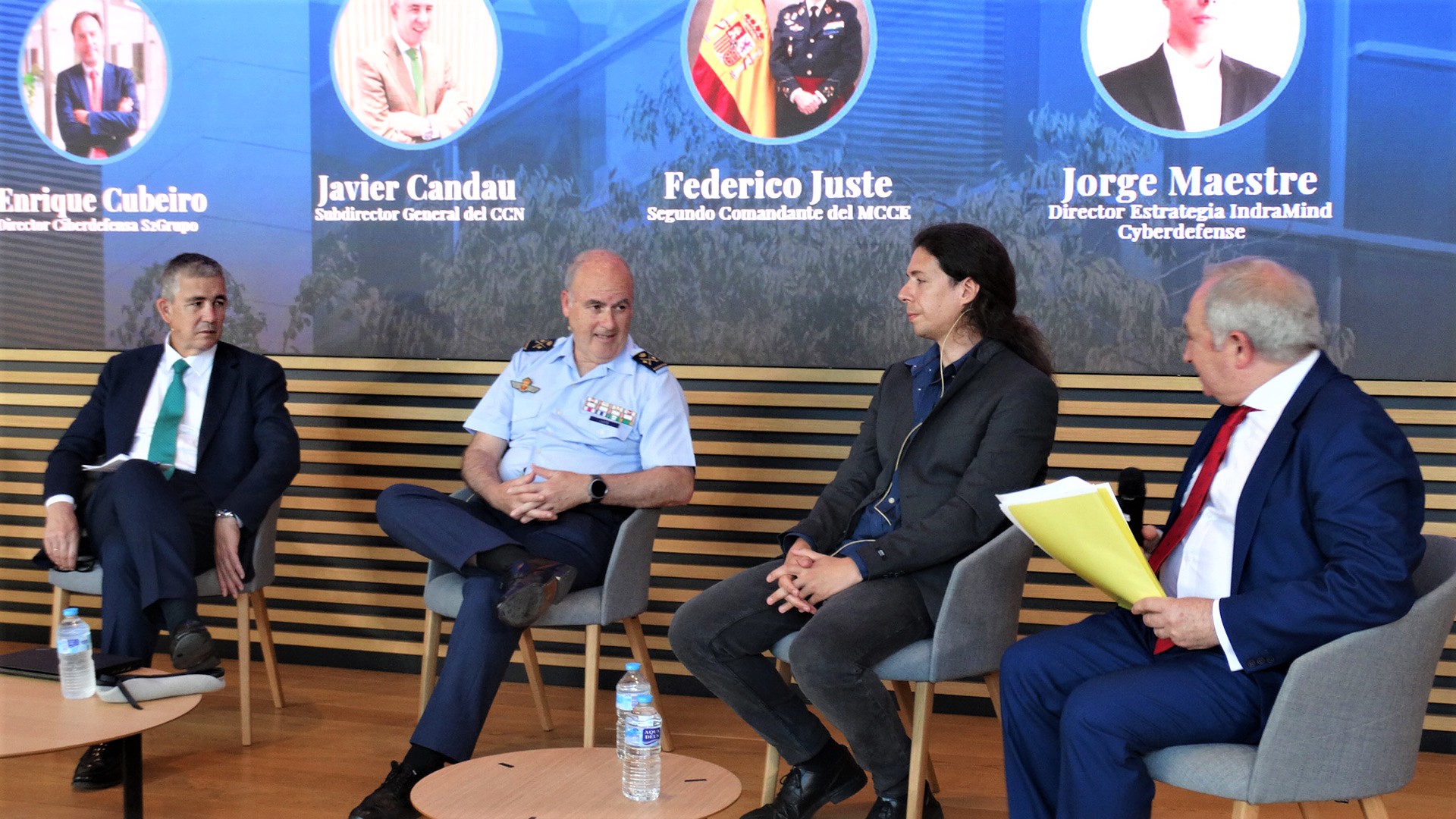
Major General Federico Juste de Santa Ana, Deputy Commander of the Joint Cyber Command (MCCE), took part in the panel discussion ‘Cyber Defence in the New Geopolitical Landscape: Security, Sovereignty and Cooperation’, held at the Arrupe Campus of the Pontifical University of Comillas ICAI-ICADE, as part of the alumni club programme promoted by the educational institution.
General Juste de Santa Ana analysed the doctrinal, technical and strategic challenges posed by the current digital landscape alongside Enrique Cubeiro, Director of Cyberdefence at S2Grupo; Javier Candau, Deputy Director-General of the National Cryptology Centre (CCN); and Jorge Maestre, Director of Strategy at IndraMind Cyberdefence. The panel discussion was moderated by Professors Javier Jarauta and Javier Martín
During his address, General Juste explained the profound transformation of military doctrine, using the conflict in Ukraine as an example, which he described as ‘the most technologically advanced in history’. The general recalled several key milestones in digital conflict, such as the cyber-attacks on Estonia (2007) and Georgia (2008), and the attack on the Ukrainian power grid using the Industroyer malware in 2016. This latest attack, he noted, prompted Ukraine to devise a digital resilience plan in collaboration with the United States, Google and Microsoft, which enabled it to safeguard its critical information in the cloud following the 2022 invasion, in a current scenario where frontline combatants operate using interactive digital tools.
Creation of the fifth domain
This global evolution, as the general pointed out, ‘consolidated an international strategic shift’. He went on to explain how, in 2016, NATO declared cyberspace to be the fifth domain of warfare — alongside land, sea, air and space — a stance adopted by the European Union in 2018, which led to the creation of specific command structures in Spain and cyber forces in Germany.
In this regard, the deputy commander of the MCCE explained that this environment has two distinctive features compared to the natural domains: it is artificial, meaning that humans can modify or destroy it, and it is cross-cutting. Given that modern weapons systems rely on microchips, any digital action directly alters the battlefield and makes it possible to neutralise the adversary preventively.
Finally, the general described the main activity of these units as taking place in the ‘grey zone’ – an area of conflict without overt military movements where attributing attacks is complex and early intervention prevents full-scale wars. Under the concept of ‘multi-domain’ operations, cyber operations work inseparably alongside traditional forces, as demonstrated by the power cuts prior to Maduro’s capture in Caracas or the air strikes in the conflict between Israel and Iran.
This dynamic, he emphasised, requires the Armed Forces to undergo a profound doctrinal shift that ‘necessitates having advanced systems deployed and regulatory frameworks permanently in place so as to be able to operate immediately when the situation demands it’.
Fotos