

The Joint Cyberspace Command presents its future projects at a key forum for the training and protection of critical infrastructure
- The Deputy Commander of the MCCE urges the acceleration of Ibero-American cyber defence in light of a 72% increase in attacks using Artificial Intelligence
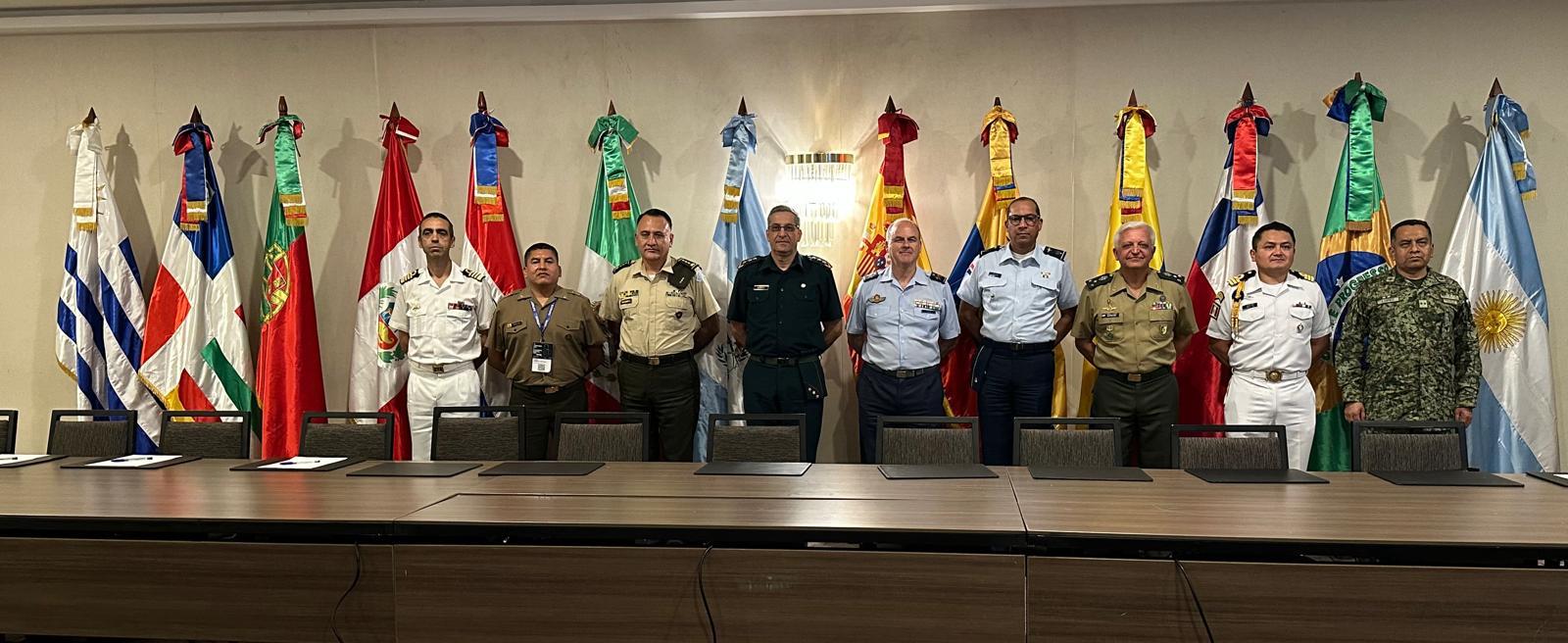
The Joint Cyber Command (MCCE) has led the second in-person meeting of the 8th Ibero-American Cyber Defence Forum (FIC), taking advantage of the simultaneous holding of the 6th STIC Conference in Santo Domingo, Dominican Republic.
The 2nd Ordinary Session of the 8th Ibero-American Cyber Defence Forum (FIC) began with a formal welcome from the Deputy Commander of the Joint Cyber Command, General Federico Juste de Santa Ana, who thanked the host country for its hospitality and invited the delegations to the upcoming STIC Conference, to be held at Kinépolis, Madrid, in November of this year. The session also featured the participation of Ana Grisel, representing the Dominican Ministry of Foreign Affairs.
The opening segment was marked by the address by Major General Juste, who described the strategic challenges of the digital age in terms of hyperconnectivity, total digitalisation and the need to adapt to new technologies. He revealed critical statistics, such as a 43% increase in global attacks and a 72% rise in cyberattacks powered by Artificial Intelligence, issuing a strong call to action encapsulated in the word ‘ACELERE’. Furthermore, a debate was opened on the feasibility of controlling cyberspace, and mention was made of advanced AI models.
During the delegations’ update session, the Dominican Republic, represented by General Jonás Donoso, emphasised the importance of strengthening international cooperation and outlined the structure of its C5, which operates through the National Cybersecurity Centre in the civilian sphere and cyber defence in the military sphere, with centres of excellence for the training of the Armed Forces.
For its part, the Mexican delegation (SEDENA and SEMAR) outlined the key points of its National Cybersecurity Plan 2025–2030, which focuses on the protection of critical infrastructure, noting that they have recorded nearly 8 million attack events, including intrusion attempts, DDoS attacks and phishing.
Brazil, for its part, took a leading role in the operational sphere by presenting the results of its 1st Military Cyber Defence System (SMDC) Exercise 2026 and detailing the preparations for the Cyber Guardian 8.0 Exercise scheduled for September, which will bring together more than 240 organisations and 2,000 participants. In addition, a joint training exercise was coordinated in which Brazil and Portugal will assume the role of the Red Team (attackers), whilst the remaining FIC countries will operate as the Blue Team (defenders) in tasks involving system hardening, incident response and threat hunting.
Finally, the other member countries shared their current situations: Guatemala reported having suffered a major cyberattack that affected 15 institutions with breaches of sensitive data; Portugal announced a classified Cyberrange for 2027 and training capabilities through its Escola de Ciberdefesa; Peru highlighted its progress in tactical preparedness and international internships; and Paraguay reported on budget management for the creation of its own Cyber Defence Command and the development of its doctrine of force employment.
Fotos