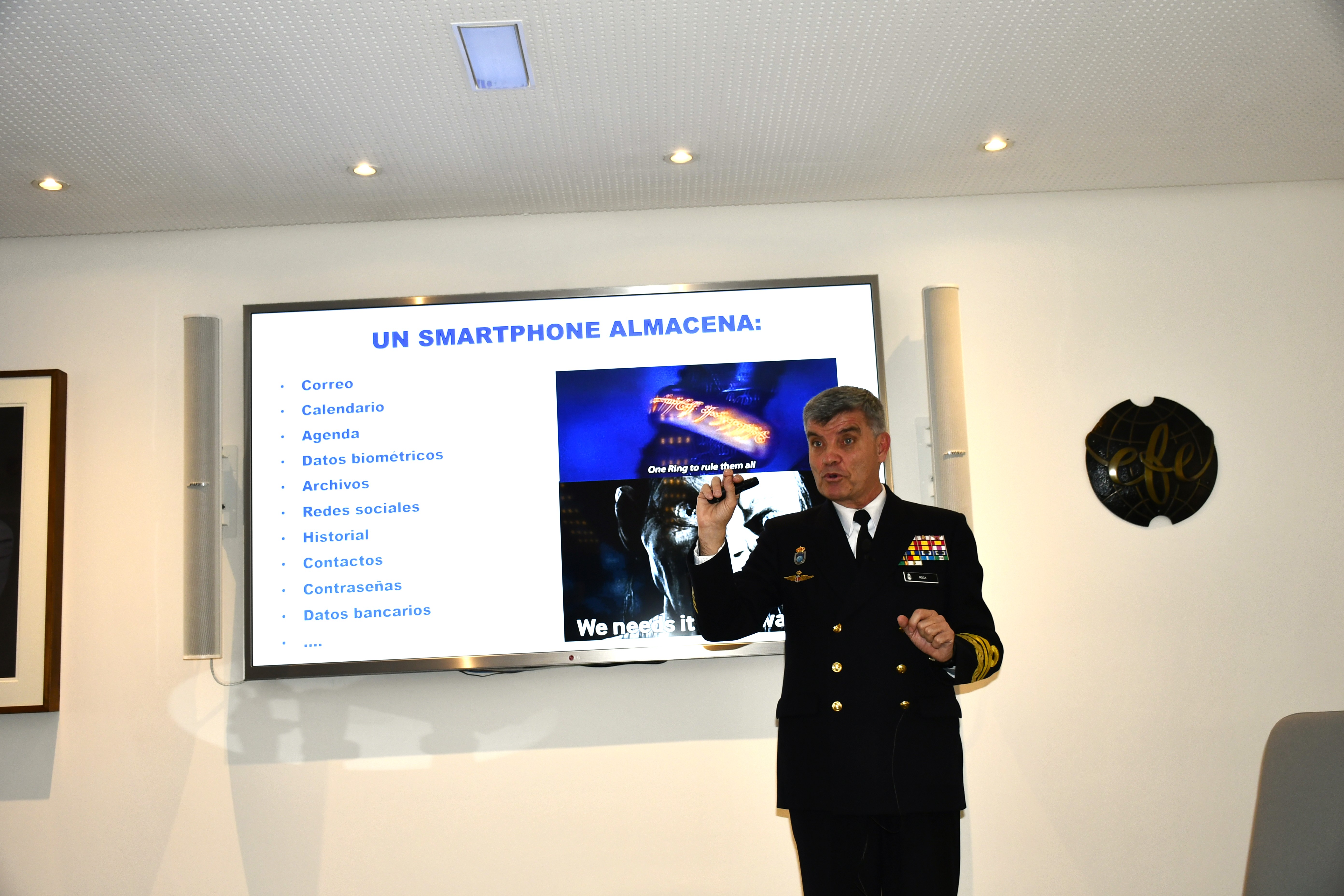


The Joint Cyber Command hosts a conference for representatives from the communications sector
- Vice-Admiral Javier Roca has been invited by the EFE news agency to raise awareness of the importance of investing in cybersecurity
The commander of the Joint Cyber Command (MCCE), Vice-Admiral Javier Roca, has been invited by the EFE News Agency to give a lecture to the agency’s senior management, leading figures from the communications sector and students on EFE’s own master’s degree course.
After being welcomed and introduced by the president of the EFE Agency, Miguel Ángel Oliver, the commander of the MCCE addressed cybersecurity as a fundamental pillar for the survival and functioning of a highly digitalised country such as Spain, which is among the most frequently targeted nations: “Spain is among the countries most frequently targeted by cyberattacks, as it is a highly digitalised country.”
He also defined cyberspace as everything that is connected and highlighted the existence of two major areas of risk. On the one hand, the information technology (IT) sector, where the most frequent and probable attacks are those aimed at data hijacking or ransomware. On the other hand, he highlighted OT technology, which is by far the most dangerous vector, as it comprises the hardware and software designed to detect or cause changes through the direct monitoring and control of physical devices, processes and events in companies or industrial plants. “It controls critical physical infrastructure, such as factory operations, water supply or air conditioning systems, the sabotage of which aims to cause real damage and not just financial gain,” he pointed out.
“One of the major complexities of this cyber domain is that it does not belong to the states, but is mostly controlled by large private technology companies. Furthermore, this battlefield is characterised by anonymity and asymmetry. This facilitates ‘false flag’ attacks, whilst asymmetry gives individuals with limited resources the ability to cause massive damage on a global scope.
Finally, the Vice-Admiral emphasised that the most critical threat is not purely technological, but human. “Professional cybercriminals focus their efforts on hacking people by exploiting their weaknesses, a threat that has now been drastically amplified by tools such as DeepFakes, powered by Artificial Intelligence, which are capable of impersonating identities, voice tones and videos in a way that is undetectable.” As he often emphasises in his speeches, the CMCCE insisted that true defence in cyberspace does not require large physical machinery, such as tanks, but brainpower and leadership.
The CMCCE thanks the EFE news agency for the invitation and for its role as a platform for raising awareness of cyber defence.
Fotos