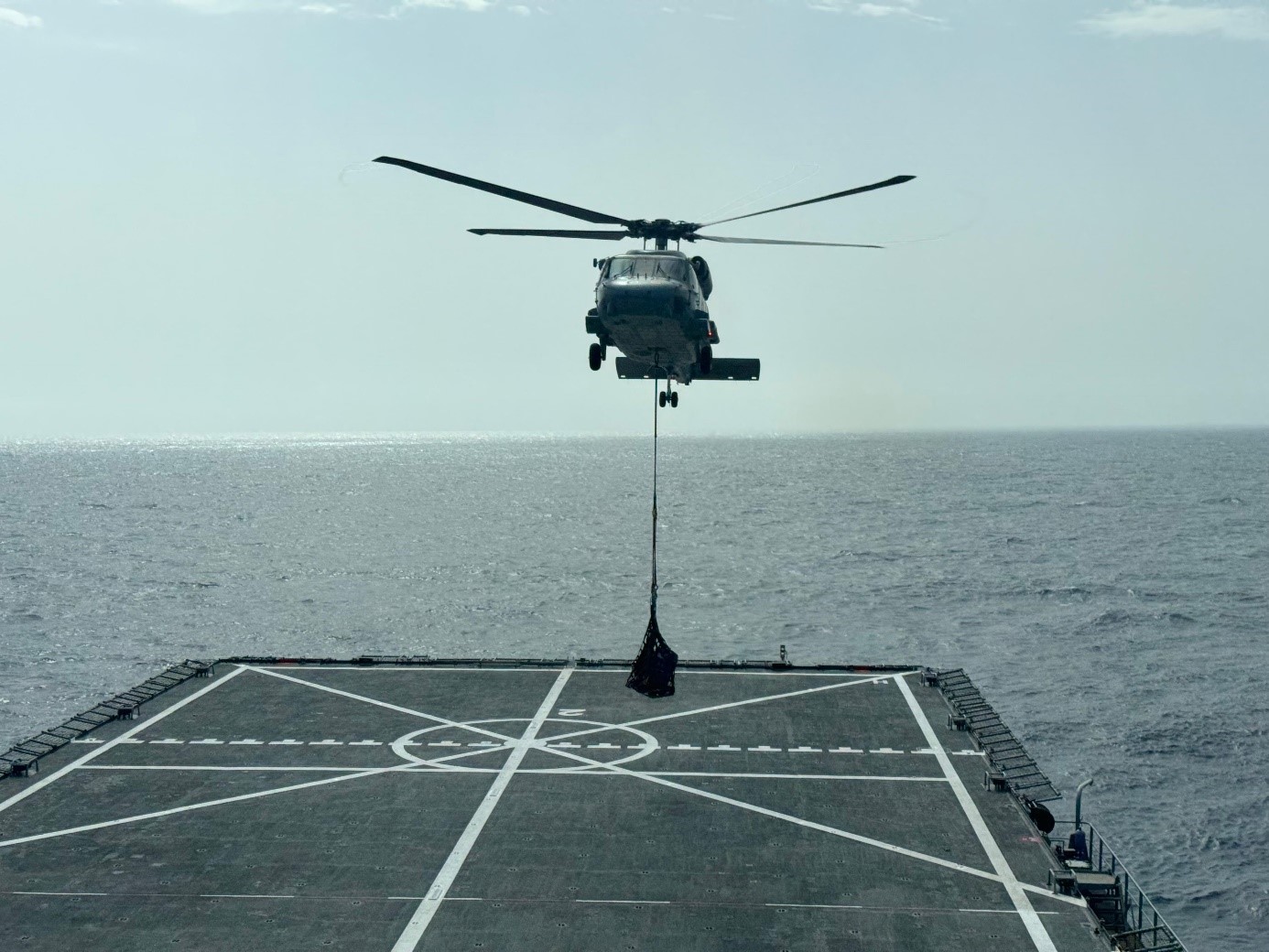


Expeditionary Battle Group “Dédalo25” begins its participation in “Neptune Strike 25”
- During a two-day voyage, the Spanish ships will sail as part of NATO's Naval Strike and Support Forces to train together
The Expeditionary Battle Group “Dédalo” today joined NATO's Naval Strike and Support Forces (STRIKFORNATO), based in Oeiras, Portugal, to conduct joint defensive “Neptune Strike 25” operational activities in Mediterranean waters.
Under the command and control of STRIKFORNATO, the aircraft embarked on the “Dédalo” will execute long-range strikes from the central Mediterranean over live-fire training areas in Croatia, Slovakia and Romania. In this context, the flight missions of the manned fighter jets taking off from the amphibious assault and aircraft carrier “Juan Carlos I” - the flagship of the “Dédalo” - will be supported by multinational strike controllers (JTACs) on land, located in Croatia, Slovakia and Romania. These JTACs are qualified to direct the actions of military aircraft engaged in close air support and other offensive air operations from a forward position. In the case of Slovakia and Romania, the JTACs will be Spanish military personnel assigned to NATO missions in those countries, as a contribution to the deployment of ground forces in support of the Allied deterrence and defence effort on the eastern flank.
On the other hand, given the need to fly these missions through the airspace of several NATO countries, in-flight refuelling through the use of multi-purpose tanker aircraft, which will be provided by the Italian Air Force, is essential.
On this integration and training opportunity, Rear Admiral Antonio González del Tánago de la Lastra - commander of the Spanish Expeditionary Battle Group - stresses that ‘the transfer of authority of our task force demonstrates Spain's sustained commitment to NATO's broader deterrence and assurance measures’. He believes that "the increase in the capabilities of our forces reflects the successful process of improvement and adaptation to new global security challenges in recent years. All in all, multi-domain, combined and joint operations with allies foster interoperability and mutual trust.
Dédalo 25
The Expeditionary Battle Group “Dédalo 25-2” is equipped, trained and ready to intervene in all domains: maritime, aerospace, land and cyberspace, with a wide range of means and advanced technology. These assets, as well as its tactics and procedures, are interoperable with the navies and armies of allied countries. In addition, it is capable of deploying around the world over a long period of time and of conducting long-range strikes.
The “Dédalo 25-2” Group will be deployed in Atlantic and Mediterranean waters until 7 July, after sailing through the Strait of Gibraltar. As for its composition, it is structured around the aircraft carrier `Juan Carlos I', which carries fighters and helicopters, accompanied by the amphibious assault ship `Galicia'; the multipurpose frigate `Blas de Lezo', with advanced anti-aircraft defence capabilities; the combat supply ship `Cantabria', as well as a reinforced landing battalion and an embarked airborne unit.
These deployments demonstrate the Navy's ability to lead and project an expeditionary force at and from sea. At the same time, where appropriate, they can integrate and operate with other allied units or groups. Therefore, Spanish forces are part of a small group of NATO countries that can enforce freedom of navigation and manoeuvre, secure maritime choke points and protect the sea line of communications. Recently, the Spanish Navy demonstrated these capabilities by contributing its assets to NATO's largest live exercise in 2025 - the “Steadfast Dart”. Now it is doing so in this peacetime operational surveillance activity “Neptune Strike”, which is carried out periodically in NATO maritime areas.
Fotos